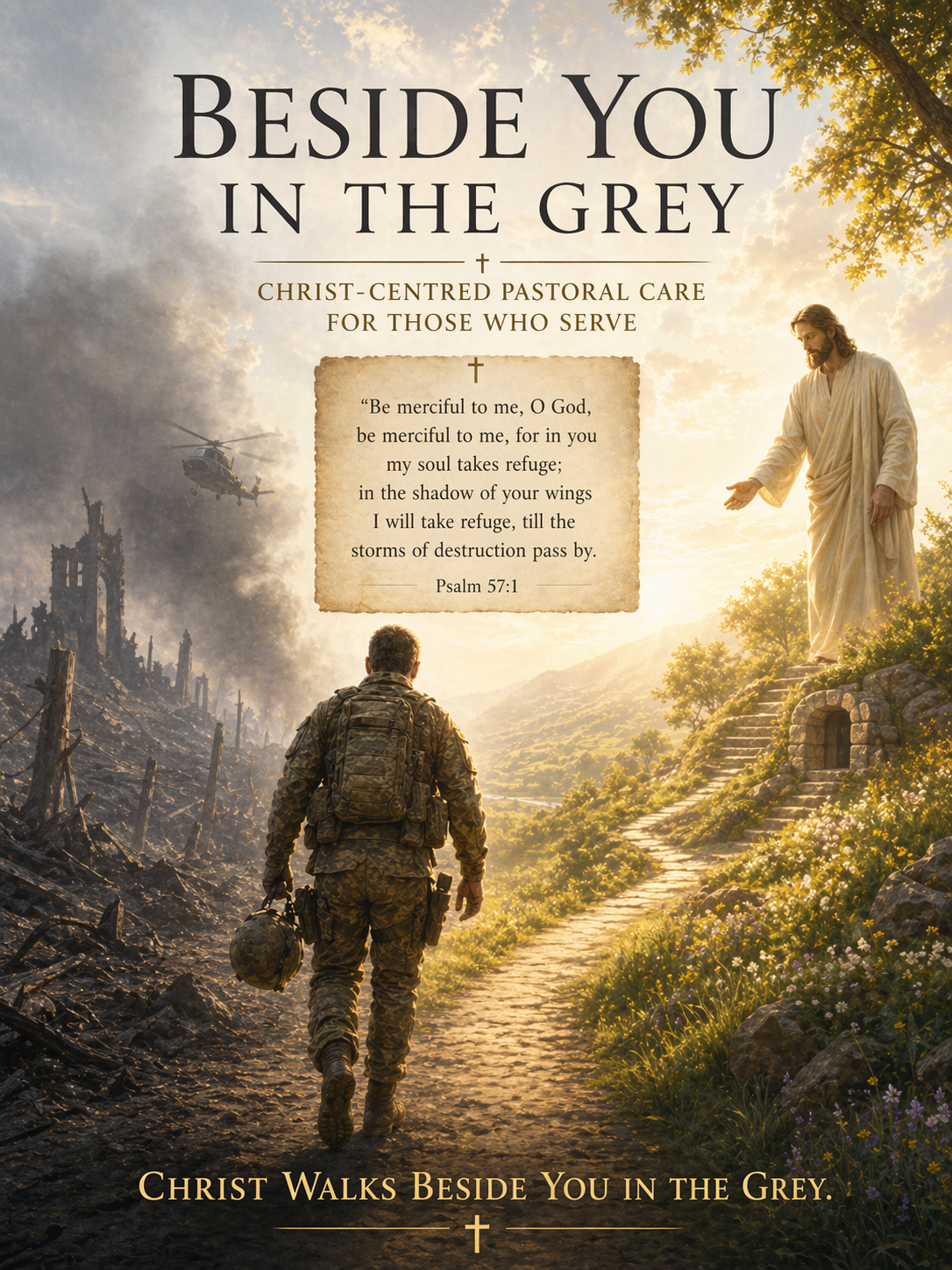
Beside You in the Grey:
Christ-Centred Pastoral Care for Those Who Serve.
Introduction — Why Our Beginnings Matter (and How We Start the Journey)
We do not step into a firefight as blank slates. We carry our childhoods with us—homes that were steady or stormy; churches that blessed or bruised; pictures of God that were kind, silent, or harsh. Those early patterns teach us what to do with fear and anger, how to ask for help, when to shut down, and whether we can trust anyone with our pain. In battle, those patterns surface fast. After battle, they shape what we can admit, how we grieve, and whether we reach for healing or hide. This is why two people can face the same ambush and walk away bearing very different burdens.
Because our beginnings vary, our path back to life has to be patient and personal. We need a gentle on-ramp that starts where people can stand. We begin with a simple step many can take: the honest admission that there is a Higher Power—reality beyond us that is for life and truth. From there, we move—unhurried—toward the God of Abraham, Isaac, Jacob, and Moses, the God who sees and hears (Exodus 3), and finally to Jesus Christ, the exact image of God, the Shepherd who lays down his life for the sheep. I have no desire to shove religion down your throat, but rather to take you on a spiritual journey toward healing at your own pace, to walk beside you without judgement. With that posture, we introduce a simple, time-tested framework that supports honest steps toward recovery: The Twelve Steps—A Spiritual Journey1.
Along the way we should try to keep the just-war rails in view, but also know that in the heat of battle our reflexes will not always allow that outcome—and God understands. And we remember God’s middle knowledge in plain terms: God not only knows what will happen; he knows what would happen down every path free people might take. His justice, then, is never rash, and his patience is never naïve. He understands the pressures those who serve face and the weight some will carry home.
God does not treat suffering as a topic. He entered it. In Jesus, God bore our fear, shame, and death—crucified by lawful men, risen with wounds still showing. Our hope is not a theory; it is the crucified and risen Christ, who meets those who serve in the very place pain is loudest.
To the Warrior
All we ask to begin is this: do you believe there is, out there somewhere, a Higher Power who is for life and truth? If that feels possible—even faintly—start here:
“Be merciful to me, O God, be merciful to me,
for in you my soul takes refuge;
in the shadow of your wings I will take refuge,
till the storms of destruction pass by.” (Psalm 57:1)
You don’t need perfect faith to pray that. Just enough honesty for today. If words are hard, use a one-line prayer: “Higher Power, hold me in your shadow; keep me steady; spare the innocent.”
I write this gently. As a child of the 1950s, living in hotels, I saw men trying to quiet what we now call PTSD—drinking too much, gambling hard, tempers flaring at home. I learnt early that those who serve can carry battles long after the uniforms are hung up. I also suffered the loss of my grandfather, who was killed on the death march out of Sandakan prisoner of war camp shortly before the end of World War II. That’s why we’ll take the next steps one day at a time, with no judgement—steady presence, honest words, and room to breathe.
A Hard Reality in a Therapeutic Age
You and I live in what has become a therapeutic society2. By that I mean we have learnt to speak about pain in the language of trauma, triggers, recovery, wellness, and coping. Some of that has been a real mercy. It has helped many people find words for wounds they once carried in silence. It has also helped some to seek care without shame. That is no small thing.
But it is not the whole truth about a wounded life.
The world you may come home to often knows how to talk about distress, but not always about duty, guilt, sin, courage, restraint, repentance, forgiveness, or evil. It may help explain your symptoms, yet still leave untouched the heavier questions: What did I do? What did I fail to do? What did I become in order to survive? Why do I feel shame even when I know I acted under pressure? Why does my soul still feel unclean when my mind can explain the circumstances?3
Therapy can help. I would not speak lightly against it. Good clinicians can be a gift of God’s common grace. But therapy is a tool, not a saviour. It can steady the nerves, help order the mind, and give language to pain. What it cannot do by itself is tell the whole moral and spiritual truth about what war does to a person.
That is why, if you feel partly helped and partly unseen, there may be a reason for it. You may be living in a world that knows how to manage pain, but not always how to reckon with the burden of having stood in the grey where split-second decisions, fear, violence, and survival all meet.
So I want to say this plainly: if you need help, seek it. Use the best care you can find. But do not imagine that healing will come by symptom relief alone. You are more than a nervous system needing regulation. You are a moral and spiritual being, made in the image of God, and what has wounded you may need more than treatment. It may also need truth, mercy, repentance where necessary, self-forgiveness, and the slow return of hope.
When Stopping Can Kill You
We honour restraint—but we also need to tell the truth. Before deployment, during the fight, and long after it, one of the great burdens placed upon those who serve is this: war does not only test skill and courage; it puts conscience and character under pressure. It can shake the person you believed yourself to be. It can force choices in seconds that may take years to think through afterwards.
You and I live in an age that teaches us to question ourselves, examine ourselves, and measure every action against its emotional and moral cost. Some of that can be wise. But in battle, there are moments when too much hesitation can get you killed, or get someone else killed. The therapeutic age is not always wrong, but neither is it always fit for the split-second realities of war.
In some fights, pausing when the danger appears past invites ambush. Enemies who reject all limits—who hide among families, glorify death, and promise more atrocities—can turn our mercy into their cover. Curtis LeMay’s grim comment sits here for a reason: if he had lost the war, he believed he would have been tried as a war criminal. Whatever one makes of the man, he understood the terrible weight of command in a world where every option can carry blood.4
Just war is not the belief that force is always wrong. It is the recognition that, in a fallen world, force may sometimes be necessary to restrain evil, protect the innocent, and make peace possible. Its purpose is not to leave you with a neat conscience, but to seek a just peace in a fallen world. That can mean pressing on longer than you would wish, until an aggressive ideology’s ability to harm is broken. But even then, pressing on must be governed, not vengeful. Otherwise, necessary persistence becomes just another form of total war.5
So even here, you need something solid under your feet. Not a slogan, and not a hatred that carries you away, but moral bearings you can hold onto when everything around you is moving fast.
You are not there to destroy a people. You are there to help stop a threat—to break the power of those who drive killing, cruelty, and terror. In the middle of that, you must still try to remember the difference between those who are fighting and those who are trapped among them. That difference can blur in the smoke, but it must not disappear from your conscience.
You also need to remember that what may seem necessary in one stage of a fight can become too much if it rolls on unchecked. The longer a conflict drags, the easier it is for force to become its own habit. That is why conscience must remain awake even under pressure. You must keep asking, as honestly as you can, whether what is being done is still aimed at restraining evil, or whether something darker is beginning to take hold.
And through it all, guard your heart. Not hatred. Not revenge. Not the punishment of a whole people for the crimes of some. The task, hard as it is, is to restrain evil without becoming shaped by it. Even while the fight is still going, do not lose sight of what must come after—repair where repair is possible, dignity where dignity can still be given, and peace if God grants it.
This is not tidy. It never will be. In the real world, some enemies do not stop when reason says they should. Some do not surrender when mercy is offered. Some use your own scruples against you. That is part of the burden those who serve carry. It is also why self-condemnation can become too simple. Sometimes you keep going not because you love violence, but because stopping too soon would hand violence back to the wicked.
That same burden often follows you home. What you did under pressure, what you feared, what you saw, and what you could not prevent may press hard upon conscience and character afterwards. This is why the soul can feel wounded even when the mind knows there was no clean option. It is also why healing cannot be reduced to symptoms alone. Part of what needs care is the shaken self—the part of you trying to understand what kind of person you were forced to be in order to survive and protect others.
So I would say this to you plainly: press on, but do not go over. Keep your sight picture as clean as you can. In the fog of battle, aim at what must be stopped, not at what is merely near. And afterwards, tell the truth about what happened. Do not hide behind slogans, but do not destroy yourself with easy hindsight either. God knows the heat of the moment better than any armchair judge ever will. He knows what was chosen, what was feared, what was seen, and what was not.
If the fight must continue, pray for clarity, not hardness. Ask for courage, not cruelty. Ask God to keep your conscience alive and your character from being bent into the likeness of the thing you are trying to stop.
The Gentle On-Ramp (Twelve-Step Rhythm, Christ-Centred)
One of the paths I have found useful in some cases, when helping people deal with trauma, is the Twelve Steps of Alcoholics Anonymous, particularly a version called The Twelve Steps—A Spiritual Journey. I do not speak of it as a cure-all, and I do not pretend it fits every person in the same way. But I have found it valuable because it respects something many wounded people know in their bones: healing usually does not begin with polished answers. It begins with honesty, small steps, and enough mercy to stand where you really are.
For some, especially where childhood, church hurt, or the things seen and done in war have made “God language” difficult, the first step may be no more than this: there is a real and trustworthy Power beyond me who is for life and truth. Today I will ask that Power for clarity and steadiness. That is not the end of faith. It is simply an honest place to begin, and the Twelve-Step rhythm understands that. It does not demand that a broken person pretend to be further along than he is.
There is another reason I want to move slowly here. In recent years, some clinical work with psychedelic therapy, especially in trauma care, has suggested that healing can sometimes begin when fear loosens, shame softens, and a person senses meaning, connection, and mercy again. I am not saying that chemical treatment and faith are the same thing. They are not. One belongs to the realm of clinical intervention; the other belongs to the life of the soul before God. But I am saying that the juxtaposition is worth noticing. Both, in very different ways, may help a broken person step out of the locked room of fear and self-hatred. Both may open a small window toward self-forgiveness, truthful speech, and the sense that we are not alone in the universe. Sometimes healing begins when the soul can breathe again.6
That is one reason I find the Twelve-Step path helpful. It makes room for that first breath. It allows a person to begin with honesty before it asks for clarity. It allows wounded people to admit need before they can name God well. It does not force a person to leap in one bound from pain to certainty.
From there, healing can begin to take on a clearer shape. The Higher Power is no longer left vague and distant, but begins to be recognised as the God who has a name and a history—the God of Abraham, Isaac, and Jacob, the God who heard the cries of slaves and came down to deliver them, the God who forbids murder and defends the vulnerable. He is not indifferent to suffering. He sees, He hears, and He acts.
And if you want to know what that God is like in the clearest possible way, you look at Jesus. He is not an abstract principle or a religious slogan. He is the face of God turned toward the wounded. He tells the truth, protects the weak, and bears scars without surrendering to hatred. In Him we see that God does not excuse evil, but neither does He abandon the broken. He enters suffering and meets us there.
In time, healing also needs somewhere to live. Not in a crowd, not under pressure, and not in religious performance, but in some small rhythm of belonging: a safe circle, a few honest prayers, Scripture read slowly, some act of service that begins to mend rather than merely survive. That is why I keep coming back to the value of the Twelve-Step rhythm as one path among others. It understands that healing is often slow, relational, and truthful. The soul usually comes back together one honest step at a time, in the presence of God, and almost always with at least one other person walking beside us.
Practices That Travel
There are a few things worth carrying with you, both into the fight and back out of it. Not because they solve everything, but because they help keep your soul from hardening and your life from coming apart.
One is prayer, even if at first it is no more than a few honest words. Something as simple as, “Higher Power—Lord, keep me from hatred, help me protect the innocent, stop me when the danger is past, forgive what I did wrong and what I could not do right, and bring me home in peace.” A prayer like that is not polished theology. It is a rope to hold when the ground is moving.
Another is the habit of telling the truth, at least to yourself and to one safe person. After a contact, after an operation, or after a hard memory returns, it helps to ask plainly: what was I aiming at, what changed, when did the danger shift, and what now weighs on me? Not to prosecute yourself at every turn, but to stop lies, bravado, and denial from becoming your only shelter.
I do not write that as theory. I had to learn some of it the hard way myself. I was a very angry young man. When things went wrong, anger was often my default setting. As I grew older, and came to Christ in my thirties, one of the hardest lessons I had to learn was self-forgiveness. Without it, I know I would have become an angry and bitter man. That lesson did not come all at once. It began with my conversion, but it has been a lifelong work of grace. That is why I say to you: do not let self-contempt become a kind of false righteousness. Telling the truth about yourself is necessary. Refusing mercy is not.
Lament matters too. Not just analysis, not just coping, but lament. There are things in war that cannot be explained cleanly and should not be rushed past. Sometimes the right response is a psalm, a silence, a name spoken aloud before God, and the refusal to turn grief into either theatre or bitterness. Lament keeps sorrow human.
Repair matters wherever it can be made. If harm has fallen and something can be acknowledged, mended, or honoured, do not despise that small work. Repair will not undo the wound, but it can stop the wound from becoming the whole story. Even the act of telling the truth, offering dignity, or refusing contempt is a kind of repair.
Home also needs gentleness. Re-entry is rarely as simple as stepping through the door. The soul may still be half-alert, the temper too near the surface, the body not yet settled. So take things steadily. Keep simple rhythms. Make room for honest conversation. Learn what helps calm the moment before it turns ugly. Do not expect yourself or those who love you to move from battle-readiness to peace overnight.
And if the symptoms stay hard—nightmares, hyper-vigilance, shutdown, hopelessness, the sense that you are no longer really present—then seek proper help. Do not do that in shame. Good care can be a mercy. You are not less of a person for needing help. You are a wounded person trying to come home truthfully.
These are not grand strategies. They are small practices, but small things often travel furthest. A prayer. An honest word. A lament. A repair. A slower step at home. A willingness to be helped. Sometimes that is how God keeps a soul alive.
Conclusion — Hope with Scars
Some enemies will fight to the death and try to take a bus full of children with them. We do not pretend otherwise. But neither do we baptise despair. Romans 13 recognises government as God’s servant to restrain evil; that does not license rage. Right intention still matters. Even in a just cause, when lines are crossed, the only honest road is truth, repentance, and whatever repair can still be made.
Our King bears scars. Crucified by lawful men and raised in mercy, He knows the cost of justice and the misery of violence. His resurrection does not erase wounds; it heals without denying them. That is why hope can be steady without becoming soft, and restraint can be strong without becoming cruel.
So let me leave you with this. Hold onto the moral line as best you can, even in the grey. Protect the innocent where you are able. Refuse the easy drift into hatred, contempt, or the lie that everyone in front of you is the same. Tell the truth about what happened. Accept mercy where mercy is needed. Seek repair where repair is still possible. And when you cannot see the road clearly, remember that Christ does not meet you at a distance. He meets you with wounded hands.
Until swords are beaten into ploughshares, ask God for clarity, not hardness; for courage, not cruelty; and for the grace to come home with your conscience still alive.
Endnotes
- Friends in Recovery, The Twelve Steps—A Spiritual Journey: A Working Guide for Healing Damaged Emotions Based on Biblical Teachings, rev. ed. (San Diego, Calif.: RPI Publishing, 1994). Archive.org record; Koorong bibliographic record. ↩
- Frank Furedi, Therapy Culture: Cultivating Vulnerability in an Uncertain Age (London: Routledge, 2004). Publisher page. ↩
- U.S. Department of Veterans Affairs, National Center for PTSD, “PTSD and DSM-5,” accessed 24 April 2026, ptsd.va.gov; U.S. Department of Veterans Affairs, National Center for PTSD, “Moral Injury - PTSD,” accessed 24 April 2026, ptsd.va.gov. ↩
- Errol Morris, dir., The Fog of War: Eleven Lessons from the Life of Robert S. McNamara (Sony Pictures Classics, 2003), transcript, “LeMay said, ‘If we'd lost the war, we'd all have been prosecuted as war criminals,’” Errol Morris transcript; James M. Scott, Black Snow: Curtis LeMay, the Firebombing of Tokyo, and the Road to the Atomic Bomb (New York: W. W. Norton, 2022). ↩
- Augustine, City of God, XIX.7, Logos Library; Thomas Aquinas, Summa Theologiae, II-II, q. 40, a. 1, New Advent. ↩
- U.S. Department of Veterans Affairs, National Center for PTSD, “Psychedelic-Assisted Therapy for PTSD,” accessed 24 April 2026, ptsd.va.gov; Alexander S. Wolfgang et al., “Research and Implementation of Psychedelic-Assisted Therapy in the Veterans Health Administration,” American Journal of Psychiatry 182, no. 1 (2025): 17–20. PubMed record. ↩
Bibliography
Augustine. City of God. Book XIX, chapter 7. Logos Library.
Aquinas, Thomas. Summa Theologiae. II-II, question 40, article 1. New Advent.
Friends in Recovery. The Twelve Steps—A Spiritual Journey: A Working Guide for Healing Damaged Emotions Based on Biblical Teachings. Rev. ed. San Diego, Calif.: RPI Publishing, 1994. Archive.org record.
Furedi, Frank. Therapy Culture: Cultivating Vulnerability in an Uncertain Age. London: Routledge, 2004. Publisher page.
Morris, Errol, dir. The Fog of War: Eleven Lessons from the Life of Robert S. McNamara. Sony Pictures Classics, 2003. Transcript available at Errol Morris: Film.
Scott, James M. Black Snow: Curtis LeMay, the Firebombing of Tokyo, and the Road to the Atomic Bomb. New York: W. W. Norton, 2022.
U.S. Department of Veterans Affairs, National Center for PTSD. “Moral Injury - PTSD.” Accessed 24 April 2026. ptsd.va.gov.
U.S. Department of Veterans Affairs, National Center for PTSD. “PTSD and DSM-5.” Accessed 24 April 2026. ptsd.va.gov.
U.S. Department of Veterans Affairs, National Center for PTSD. “Psychedelic-Assisted Therapy for PTSD.” Accessed 24 April 2026. ptsd.va.gov.
Wolfgang, Alexander S., et al. “Research and Implementation of Psychedelic-Assisted Therapy in the Veterans Health Administration.” American Journal of Psychiatry 182, no. 1 (2025): 17–20. PubMed record.