Did Biblical Just War Theology Survive the First World War?
Trench warfare, industrial slaughter, and the crisis of Christian moral reasoning
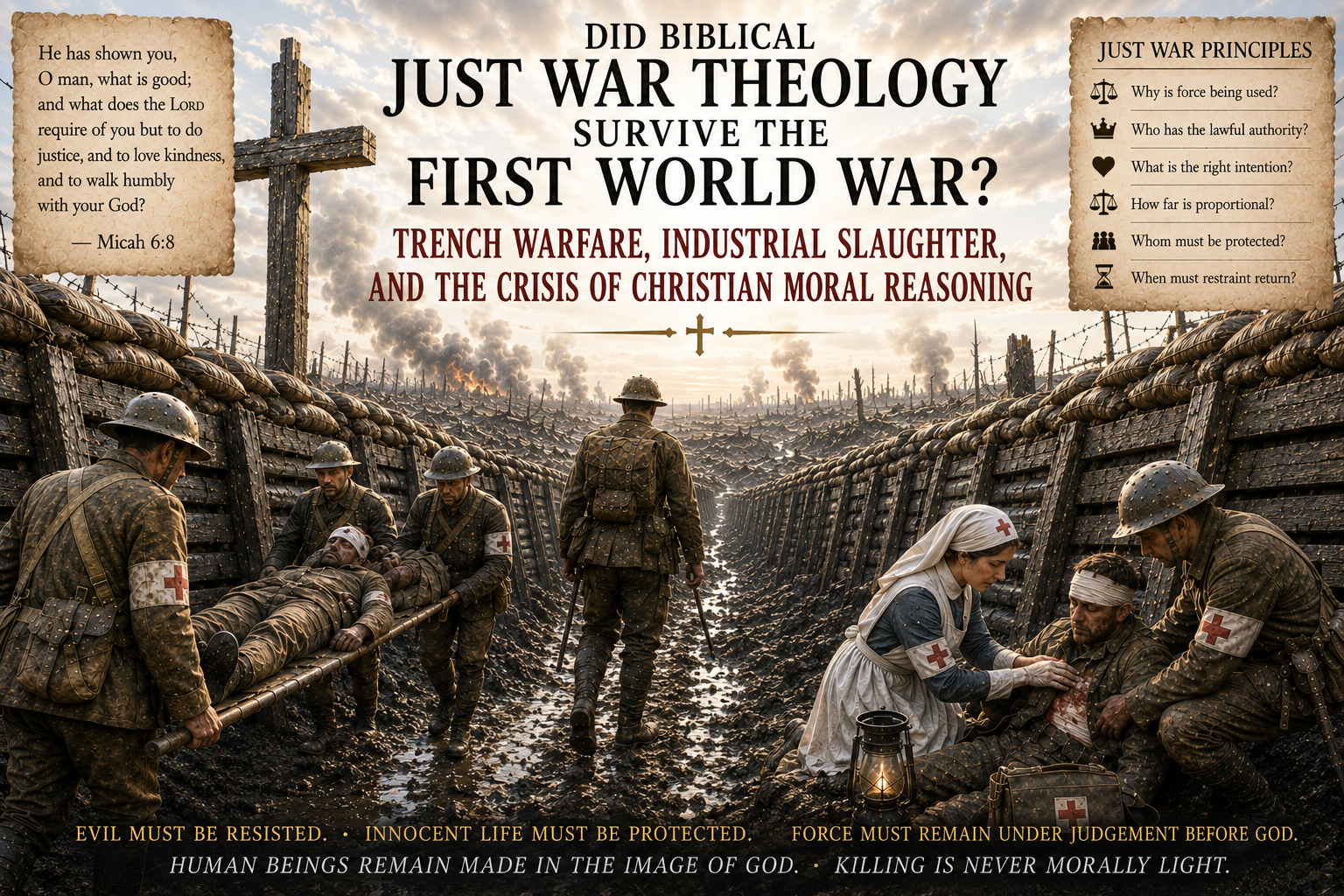
A Brief Just-War Definition
Biblical just-war theology asks a few plain questions:
- Why is force being used?
- Who has the lawful authority to use it?
- What is the right intention?
- How far may it go without becoming disproportionate?
- Whom must it protect, especially the innocent and non-combatant?
- When must restraint return, once the danger has passed?
It is not a way of dressing war up in moral language. It is a way of keeping force under judgement before God. It insists that even where evil must be resisted, human beings remain made in the image of God, and that killing is never morally light.
1. Opening Question — Did Biblical Just War Theology Survive the First World War?
The First World War did not merely test armies, alliances, and empires. It tested conscience. It tested whether biblical just-war theology could still speak truthfully in a world of trenches, barbed wire, poison gas, artillery barrages, and industrial killing. It asked whether Christian moral reasoning was equal to a form of war that seemed to consume whole generations without honour, proportion, or visible limit. So the question before us is not small: did biblical just-war theology survive the First World War, or was it buried beneath the dead of the Somme, Verdun, Passchendaele, and Gallipoli?
To answer that question, we must first remember that Europe did not drift into 1914 as a spiritually empty civilisation. Churches still stood. Christian language still shaped public life. Many ordinary people still prayed, worshipped, and buried their dead within the old forms of the faith.1 Yet beneath that visible continuity, the ground had been shifting for a long time. The Europe that entered the war was armed not only with rifles, shells, and railways, but with rival ideas about truth, power, history, nation, and man himself.
The philosophies of the late nineteenth and early twentieth centuries did not by themselves create the First World War. Assassinations, alliances, imperial rivalries, nationalist passions, arms races, and failures of political judgement did that more directly.2 But those philosophies certainly fertilised the ground. In many quarters they loosened older Christian restraints, weakened confidence in transcendent moral order, and made it easier to treat struggle, force, race, class, nation, or history itself as though they were ultimate realities. This was not Darwin’s biological work by itself, but what later thinkers and movements did with evolutionary ideas once they were lifted out of natural science and made to carry social, political, and moral meaning. Social Darwinism, in particular, turned natural struggle into cultural justification, and in some circles it was used to rationalise racism, colonialism, and hierarchy. Marx pressed Europe toward a material reading of history and society in which religion could be treated as alienation and human life increasingly interpreted through class, labour, and historical process. Nietzsche attacked Christianity and traditional morality at a deeper level still, helping many to imagine a Europe less governed by inherited Christian restraints. They did not abolish conscience; they retrained it. Once man was seen less instinctively as one made in the image of God and more as an autonomous self, a social unit, or a being shaped by struggle and utility, it became easier to justify what older Christian conscience would once have named more quickly as evil.3
That shift mattered. A civilisation can keep its churches and still lose its moral centre. Europe before the war had become increasingly confident in progress, industry, science, administration, and the organising power of the modern state. Yet beneath this confidence lay deep spiritual disorders: pride dressed as patriotism, fear baptised as duty, national ambition clothed in moral language, and an increasingly shallow belief that technical mastery could save man from the darker truths about his own heart. The old sins had not vanished. They had become mechanised.
Nor was the crisis confined to philosophers and politicians. The churches themselves were not untouched. Christian faith remained alive, but it was often entangled with national destiny. Too often the church stood close enough to the flag that it struggled to speak with full independence when Europe began marching toward catastrophe. The result was not that Christianity disappeared, but that Christian loyalties were frequently mixed with national loyalties in ways that blunted moral clarity at the very hour it was most needed.4
In this sense, the First World War was a spiritual crisis before it was a military one. It exposed the fragility of a civilisation that still used Christian language, but had already begun to trust too deeply in power, progress, and the moral innocence of its own cause. It also exposed the poverty of any moral system built on optimism about man. The trenches did not create original sin. They revealed it in mud, blood, and iron.
This is why the question of just-war theology matters so much. If biblical just-war reasoning was merely a respectable cloak for state violence, then the Great War should have finished it. But if it was a serious attempt to restrain evil, protect the innocent, and hold rulers and nations accountable before God in a fallen world, then the war, however terrible, did not make it irrelevant. It made it necessary.5
My argument is that biblical just-war theology did survive the First World War, but it survived bloodied. It survived not because the war was clean, and not because the churches were unconfused, but because the tradition was never built on illusions of human goodness or perpetual progress. It was built for a world in which evil must sometimes be resisted, even though the resisting of it wounds those who undertake the task. The Great War did not destroy that tradition. It forced it back to its first principles.
2. The Old World Breaks
When war came in August 1914, Europe still thought of itself as civilised, rational, and in command of its own future. It had railways, factories, banks, universities, parliaments, churches, and proud armies. Many assumed the war would be hard, but short. Yet once mobilisation began, events moved faster than the judgement of the men directing them. The old Europe was about to discover that it had prepared for war without truly understanding what war had become.6
The armies that marched in 1914 still thought largely in terms of movement, offensive spirit, and decisive battle. But the battlefield had changed underneath them. Firepower had advanced more quickly than mobility. Bolt-action rifles, machine guns, and rapid-firing artillery had made exposed ground murderous, while armies still moved at the pace of marching men and horses. The days of muskets, ordered marching lines, and battle as something almost visible and comprehensible to the eye were over. War had become industrial, obscured, and mechanically lethal. That was not only a military change. It was a moral one. Men schooled in older ideas of courage and advance found themselves in a world where survival depended less on dash than on earth, wire, concealment, and endurance.7
That mismatch broke the old world quickly. In the opening months there was still movement, still manoeuvre, still the hope that offensive action might bring a decision. But firepower imposed its own logic. Soldiers dug because they had to. By the end of 1914, the Western Front had hardened into entrenched systems stretching for about 700 kilometres (roughly 435 miles) from the Swiss frontier to the North Sea. What followed was not a brief pause, but a new kind of battlefield — trenches, dugouts, belts of barbed wire, strongpoints, shell-holes, and broken ground over which men were sent again and again at fearful cost.8
And that battlefield ran on more than rifles and courage. It was fed by industrial logistics: railways, depots, shells, food, fuel, animals, engineers, replacement drafts, and the endless labour needed to keep millions of men killing, surviving, and enduring. It also brought new terrors. Poison gas did not stand apart from the war’s logic; it belonged to it. Artillery remained the great killer, but gas added choking fear, blindness, burning lungs, and lingering dread to a battlefield already ruled by machinery and mass fire. The slaughter dwarfed what Europe had known before. Millions were killed, millions more were wounded or maimed, and the political leaders who had opened the war discovered that they had set loose forces they could still feed, but no longer morally master.12
What broke, then, was not only the line of advance. A whole moral and cultural inheritance began to crack. Nineteenth-century Europe had fed itself on confidence — progress, science, administration, national energy, technical mastery. But the battlefield turned those achievements into instruments of prolonged destruction. Europe brought all its cleverness to the war, and instead of saving life it learned how to destroy it more thoroughly. The machine did not replace sin. It magnified its reach.9
Yet even the trench was not the final word. In time, the war showed that the defender’s advantage was not absolute. It took further advances in mechanical technology and operational art to begin loosening the deadlock — better artillery methods, tanks, aircraft, improved communications, harder-won staff work, and a tighter joining together of all arms on the battlefield. The arrival of American forces in large numbers in 1918 altered the balance further, not only in material strength but in morale and expectation. And the Australian General Sir John Monash showed what happened when the scattered instruments of modern war were brought to bear together — infantry, guns, tanks, aircraft, engineers, timing, and supply. It was not beautiful. But it was deliberate, ordered, and devastating. In the Hundred Days, that kind of orchestration helped turn industrial war against the trench system itself and push the conflict toward armistice.13
This is why the First World War felt like more than another European conflict. It was not simply that men died in vast numbers, terrible as that was. It was that the inherited language of honour, courage, patriotic sacrifice, and Christian civilisation had been forced into a world of mud, shellfire, gas, shattered bodies, and repeated assaults on fortified systems. Courage did not disappear. But it could no longer be romanticised so easily. Bravery was still real, yet it was now swallowed up inside machinery, logistics, wire, and fire in ways the older imagination of battle had not prepared men for.10
The old world also broke because Europe discovered that modern civilisation had not outgrown Cain. Beneath the music, learning, liturgy, and political sophistication of Christian Europe there still lay the old human materials: fear, pride, rivalry, envy, and the will to prevail. The war stripped away comforting illusions. It showed that an advanced civilisation can still organise slaughter with efficiency, persistence, and moral self-assurance. That discovery was not merely strategic. It was spiritual.11
So when we say that the old world broke, we do not mean only that military doctrine failed or that empires began to crack. We mean that Europe’s confidence in its own moral and civilisational maturity suffered a wound from which it would not recover quickly. The trench, the barrage, the wire, the gas cloud, and the endless train of supplies became more than military facts. They became signs of a deeper unravelling. And it was in that unravelling that biblical just-war theology faced its great test: could it still name limits, responsibility, and justice when the battlefield itself seemed designed to erase them?
3. Why the Great War Became a Theological Crisis
The Great War became a theological crisis because it did not only tear up fields, towns, and bodies. It shook the words people had long used to speak about God, justice, duty, sacrifice, mercy, and neighbour. Many soldiers and civilians on every side still prayed to God as they understood him for protection, victory, survival, or deliverance. Men in trenches prayed. Mothers at home prayed. Chaplains prayed. Priests prayed. The wounded prayed. The dying prayed. That is part of what made the crisis so sharp. People had not stopped believing. They were still crying out to God while the world around them was being pulled to pieces.14
It was a theological crisis because Christian nations were fighting Christian nations, and churches too often stood close enough to the flag that they struggled to speak with full freedom. Theology was not standing outside the war, judging it calmly from a safe distance. It was inside the storm — preaching, consoling, burying, blessing, and at times justifying. Once that happens, the old just-war questions become harder to hold steady. Lawful authority still matters, but what happens when rival governments each claim justice before God? Right intention still matters, but what happens when duty, patriotism, fear, grief, anger, and love of one’s own people are all mixed together in the same heart?15
The Great War also became a theological crisis because it bent every just-war rail under pressure at once. Just cause was clouded by propaganda, rivalry, and national myth. Proportionality was stretched by artillery, blockade, gas, and attrition. Discrimination was wounded by a kind of war in which whole societies were drawn into the struggle, and the line between battlefield and home front grew thinner by the year. The old moral rails were not abolished, but they were bent hard. The battlefield did not make theology unnecessary. It made theology answer questions many had not wanted to face.15a
It became a theological crisis because it exposed something rotten inside Christian civilisation itself. Europe still had churches, liturgy, and Christian language. It still spoke of duty, honour, and God. Yet it brought all its science, industry, administration, and intelligence to the organised killing of men on a scale not seen before. That is why the war was more than a military disaster. It was a spiritual exposure. It forced Christians to ask whether Europe still believed, in any deep way, that man was made in the image of God. If that truth had thinned in Europe’s imagination, then war would not only kill bodies. It would also unburden conscience.
And this crisis did not stop at the borders of Western Europe. The war widened into a global religious strain. On the Ottoman side, religion was openly drawn into the conflict through the declaration of jihad. Elsewhere too, faith could be pressed into the service of empire, nation, and survival. That does not mean every believer thought alike. Far from it. But it does mean the problem was wider than Christian Europe alone. Modern states had learnt how to make sacred words serve political ends. Once that happens, theology comes under strain everywhere.16
This is where C. S. Lewis helps us, even though he is not the main theologian of the story. Lewis carried the First World War in his own flesh before he became the Christian writer people now remember. What he later saw clearly was that war does not create a brand-new human problem so much as force the old one upon us with terrible weight. Death, fear, judgement, courage, duty, and God are always there. War drags them into the open. In that sense Lewis helps us see why the Great War became theological. It forced people to face death, guilt, providence, sacrifice, and judgement without the usual comfort of peacetime distance.17
Karl Barth matters here too, though in another way. The war helped him see that the easy confidence of liberal Protestantism in culture, progress, and moral uplift had not saved Europe from catastrophe. That matters because it shows the crisis was not only in politics or military command. It was also in theology itself. A theology that leans too heavily on the goodness of its own age will not stand when history catches fire.18
So the Great War became a theological crisis because it forced believers to ask questions that could not be answered by patriotism, sentiment, or mere survival. Can nations pray to the same God for opposite victories? Can the church speak truthfully when it is wrapped too tightly in national destiny? Can just-war reasoning still name restraint when war becomes industrial, prolonged, and morally disorienting? Can a civilisation still call itself Christian when it has learnt to organise death on such a scale?
Those are not side questions. They are the heart of the matter. The Great War became a theological crisis because it drove faith, conscience, nation, and violence into the same furnace. What came out was not easy clarity, but the hard need for theology to become humbler, truer, and less impressed with the innocence of its own civilisation.
4. What Biblical Just-War Theology Had to Hold Onto
If biblical just-war theology was to survive the Great War, it had to hold onto something deeper than civilisation’s self-image. That had already cracked. It had to hold onto truths older and tougher than modern Europe’s confidence in itself. Above all, it had to hold onto the truth that man is still made in the image of God, even when he is dressed in mud, fear, lice, and khaki, even when he is trapped in a trench system that treats him like part of a machine.19
That truth was often badly obscured. At the level of states, staffs, propaganda, and industrial killing, men were too easily reduced to numbers, replacements, rations, and objectives. But the image of God was not erased. In the trenches themselves, mateship, care for the wounded, reverence for the dead, and the refusal to abandon one another remained strong. Men still carried each other. They still wrote home. They still shared food, fear, and prayer. They still risked themselves for the bloke beside them. That does not redeem the war. But it does show that even there, something human and moral remained stubbornly alive.20
This matters, because biblical just-war theology does not begin with the innocence of civilisation. It begins with the worth of the person before God. If that is forgotten, everything else goes with it. Proportionality becomes arithmetic. Discrimination becomes convenience. Military necessity becomes a slogan that swallows conscience whole. But if the person remains visible — the wounded man, the frightened stretcher-bearer, the prisoner, the civilian, even the enemy dead — then the old rails can still be named, even in ruin.21
That is why the scattered truces matter. They were not widespread enough to change the character of the war. They did not stop the killing for long. But they were not nothing. The Christmas Truce of 1914, in those sectors where it appeared, saw men sing carols, meet in no man’s land, exchange small gifts, and gather their dead for burial. The Gallipoli armistice of 24 May 1915 likewise paused the fighting so bodies could be recovered and buried. These were not victories for sentiment. They were small acts of recognition. They showed that even after months of slaughter, some men still knew that the dead should not be left to rot between the lines, and that a holy day was still holy enough to interrupt hatred, if only for a moment.22
So what did biblical just-war theology have to hold onto? It had to hold onto the image of God, not as a slogan, but as a truth stubborn enough to survive mud and wire. It had to hold onto neighbour-love, not in sentimental language, but in stretcher work, burial parties, letters home, shared rations, and the plain refusal to let the wounded man become an inconvenience. It had to hold onto the Sixth Commandment as a real restraint, even in war: not a denial that force may be necessary, but a reminder that killing is never morally light, and that the moment the danger passes, restraint must return.21
It also had to hold onto lament. The Great War could not be answered with triumphal language alone. Too much had been lost for that. Biblical faith gave the church a language not only for duty and courage, but for grief, confession, and sorrow. If theology was to survive, it had to tell the truth about shattered bodies, maimed minds, broken families, and graves stretching across Europe and beyond. A faith that cannot lament will quickly become a servant of power.
And it had to hold onto moral distinction. Not every enemy was the same. Not every act of killing was equally justified. Not every order was equally clean. Just-war theology had to insist that even in total war, not everything lawful is righteous, not everything possible is permissible, and not everyone across the line is stripped of creaturely dignity. That is hard to hold in battle. Harder still after battle. But without it, war simply becomes organised vengeance with better uniforms.
In the end, biblical just-war theology survived the Great War because the war did not fully extinguish the truths it depended on. Those truths were bent, obscured, mocked, and often betrayed. Yet small sparks of the human and spiritual centre were still alive in the ruins. They were not destroyed. They remained wherever one man carried another, wherever the dead were buried with some reverence, wherever hatred paused long enough for a hymn, a prayer, or a burial party, and wherever conscience still whispered that the man across the wire was not only an enemy, but also a fellow creature under God.
That, I think, is what theology had to hold onto. Not the fantasy that the war was cleaner than it was. Not the boast that Christian civilisation had acquitted itself well. But the harder and humbler truth that even in the wreckage, the human person still bore God’s image, and that this truth remained the one firm ground from which restraint, mercy, and justice could still be spoken.
5. Where the War Drove Just-War Theology to Breaking Point
If one wanted to argue that biblical just-war theology did not survive the First World War, the case would not be hard to make. It would begin here: the war did not merely strain the old moral categories. It made them look as though they were buckling under a weight they had not been built to bear.
Just-war reasoning had always assumed that war, though tragic, still moved within some recognisable moral frame. Cause could be weighed. Authority could be examined. Intention could be judged. Conduct could be restrained. But the Great War pushed all of that toward breaking point. Trench warfare became organised attrition. Men were not only sent to fight; they were fed into systems of exhaustion where ground was counted in yards and loss in thousands. At that scale, the old language of proportionality began to sound thin. A tradition built to restrain war now faced a form of war that seemed to consume men by design.23
The pressure grew worse because the war no longer sat neatly at the front. Total mobilisation blurred the old distinction between combatant and non-combatant. Industry, transport, agriculture, factories, finance, shipping, propaganda, and labour all became part of the war effort. Whole societies were drawn into the struggle. The battlefield was still real, but it was no longer the whole battlefield. Once entire nations were organised for war, the old moral lines were harder to see and harder still to defend with confidence.24
In the age of empire, that distortion was sharpened by the logic of modern state power itself. The ordinary citizen was increasingly valued not simply as a neighbour made in the image of God, but as material for the nation, the factory, and the battlefield. In Imperial Germany that temptation was intensified by Prussian political-military culture, aristocratic habits of command, military prestige, and the hunger for world power. But the disease was not Germany’s alone. Across Europe, modern states were learning to measure human beings by usefulness to national destiny. People became disposable. At home they could be organised, worked, rationed, censored, and spent for the war effort. In occupied territories they could be restricted, uprooted, exploited, and bent to purposes not their own. In the trench they could be sent forward again and again into systems that devoured life with industrial regularity. Once that happens, just-war restraint is already in danger, because the person begins to disappear behind the cause.25
Then there was the widening moral distance created by artillery, gas, and bureaucracy. A man could once imagine battle in more immediate human terms, terrible as it was. But now death came through shells fired from miles away, through gas clouds drifting over unseen men, and through administrative systems that turned bodies into numbers, needs into logistics, and losses into calculations. Killing became less personal in one sense, yet more vast in another. The distance did not cleanse it. It made it easier to manage without looking too long at what was being done. Human beings could be destroyed by men who never saw their faces, and supplied to the front by offices that never smelled the blood.26
Propaganda deepened the distortion. Just-war theology requires truthful moral judgement. But modern war fed nations on simplification, myth, and self-righteousness. Every side was tempted to imagine itself morally clear, providentially favoured, and fundamentally innocent. The enemy became not merely wrong, but morally useful as a symbol of evil. Once national myth begins to speak more loudly than truth, the tradition of moral restraint is already in danger. A theology that should have judged the nation could instead become its echo.27
Nor was this only a problem for politicians and newspapers. Soldiers grew exhausted in body and spirit. Clergy and chaplains were often exhausted too. Churches buried, blessed, comforted, and endured, but they did so under crushing strain. Some spoke bravely. Some spoke too closely to the nation. Some lacked the distance, freedom, or courage to say what restraint, lament, and truth required. Men who had seen too much death could grow numb. Pastors who ought to have named sorrow and limits could drift into patriotic reassurance. In that atmosphere, it could seem that the church had not stood above the war with moral clarity, but had been swallowed into it.28
From there the darkest conclusion comes into view. Perhaps the Great War did not merely wound just-war theology. Perhaps it exposed it as too weak for modern war altogether. Perhaps the old categories — just cause, proportionality, discrimination, right intention — remained admirable in theory, but had become nearly unusable in practice once war turned industrial, total, bureaucratic, and spiritually disfigured. Perhaps the tradition survived only on paper, while the battlefield, the occupied town, the ration line, the casualty list, and the burial detail rendered it mute.29
That is the hardest question this section must leave hanging. Not whether the war was terrible. That is obvious. But whether the war became so morally deformed, and human beings so disposable, that the old Christian grammar of restraint could no longer carry the weight placed upon it.
6. Why the Tradition Was Not Destroyed
If the story ended only with attrition, propaganda, exhaustion, mutiny, and men made disposable, one might well conclude that biblical just-war theology had not survived the First World War at all. That case has to be faced honestly. The war did drive the old moral language to breaking point. It did expose the weakness of churches, the folly of leaders, and the frightening ease with which modern states could spend human beings for ends they no longer clearly justified.
Yet the tradition was not destroyed. It was bloodied, bent, obscured, and often betrayed. But not destroyed.
One reason is that the war itself began to expose the bankruptcy of unlimited command. Leadership had wasted much of its moral authority by refusing to let go of earlier doctrines, and by asking men to keep paying in blood for assumptions the battlefield had already judged false. By 1917 and 1918, that truth was no longer abstract. In different ways, across different armies, men had begun to reach the limit of what they would bear. Mutiny, refusal, bitterness, and collapse were not tidy acts of Christian moral reasoning. They were mixed with grief, anger, fear, politics, and exhaustion. But they did reveal something important: obedience is not morally infinite. Men were no longer willing to be spent without end simply because command demanded it.30
That matters for this argument. The just-war tradition was never meant to teach blind compliance with power. It was meant to place power under judgement. A ruler may bear the sword, but he does not own the human soul. A state may command service, but it does not possess an unlimited right to waste the lives entrusted to it. Once that truth begins to press back against command, however confusedly, one sees that the tradition has not been extinguished. Its central moral nerve is still alive.31
The tradition also survived because the war did not succeed in making utility the same thing as righteousness. Industrial war tempted every nation to believe that whatever worked must therefore be justified. But biblical just-war theology had always said otherwise. Not everything useful in war is morally lawful. Not every military advantage is worth its price. Not every order that can be given should be obeyed without question. Not every means that promise success may be taken up with a clear conscience. The war did not cancel those truths. It proved how badly they were needed.32
This is where men like Monash matter. He does not belong in the story as a redeemer, and certainly not as a romantic hero who made war clean. He belongs here because he showed that command did not have to remain imprisoned in illusion. When leadership finally learned to think more truthfully about the battlefield — to plan carefully, coordinate arms, respect timing, supply, terrain, and the actual conditions under which men fought — some of the old waste could be checked. That did not remove tragedy. It did not turn battle into something morally light. But it did show that command could still be judged. It could still be asked whether it was acting with discipline, proportion, and care, or merely throwing men forward to satisfy prestige, habit, and false doctrine.33
In that sense, the tradition survived not by pretending the war was just in all its dimensions, but by continuing to expose the difference between necessary resistance and futile slaughter. It survived because men still knew, even in exhaustion, that there is a difference between standing against aggression and being consumed by an endless appetite for offensive sacrifice. It survived because the old moral distinctions kept forcing themselves back into view, even when states and staffs had grown careless with them.
It survived in another way too: by refusing triumphal speech. A moral tradition that can only bless victory is not a Christian tradition worth keeping. Biblical just-war theology endured because it still had language for lament. It could still say that some wars may be necessary, and still say that what happens in them is grievous. It could still acknowledge duty without baptising slaughter. It could still speak of courage without pretending courage makes devastation clean. It could still insist that even where force is used lawfully, it leaves behind sorrow, guilt, graves, and the need for repentance. That is not weakness. That is moral seriousness.34
And it survived because it preserved the distinction between justified resistance and the unlimited logic of total war. The Great War pushed hard against that distinction. It blurred battlefield and home front, soldier and worker, citizen and instrument. It taught states to think in masses, systems, production, and endurance. But even then, the distinction was not finally lost. The old truth remained: there is a difference between defending the innocent and treating whole peoples as expendable; between resisting evil and becoming intoxicated with power; between the tragic use of force and the fantasy that force can save us by its own strength.35
That, I think, is why the tradition was not destroyed. It survived because the war could not finally erase the truths on which it rested. It could wound them. It could mock them. It could drive them into the mud. But it could not abolish the fact that authority must answer to justice, that human beings are not mere material for the state, that truth matters in war, that restraint matters in war, and that sorrow belongs wherever killing does.
So the First World War did not destroy biblical just-war theology. It stripped it of illusions. It drove it back to first principles. It showed that if the tradition was to endure at all, it could endure only as a wounded moral discipline — one still insisting that power is not innocence, that usefulness is not righteousness, and that even in war the human person remains under God, not beneath the absolute claim of the nation.
7. The church, the chaplain, the healer, and the ordinary soldier
If biblical just-war theology survived the Great War at all, it survived not first in parliaments, staffs, or patriotic slogans, but in wounded ministries and wounded consciences. It survived wherever the church still knew how to pray, bury, lament, bless, and tell the truth about death. It survived wherever chaplains refused to let men become mere material for the state. It survived wherever doctors and nurses tended shattered bodies as bodies that still belonged to persons, not merely to the war machine. And it survived wherever ordinary soldiers, however inarticulate their theology may have been, still carried one another, buried the dead with some reverence, and retained enough conscience to know that duty did not cancel humanity before God.36
The church entered the war compromised. That fact should not be softened. Too often it stood too close to the flag, and too often its language of sacrifice and duty was mingled with the passions of nation and empire. Yet even so, the church still carried something the modern state could not generate for itself: a moral and liturgical vocabulary for sin, mercy, guilt, burial, lament, and hope. The state could issue orders, count losses, and print communiqués. It could not pray with the dying, bury the dead as persons rather than refuse, or teach the living how to grieve without surrendering altogether to hatred. For all its failures, the church still held open that language, and in doing so it kept alive one of the last surviving barriers against the total disappearance of the human person behind the cause.37
That language had to be carried by someone, and in the trench system it was often carried by chaplains. The chaplain stood in an uneasy place: not fully of the line, yet never wholly outside it; close enough to command to be used by it, close enough to wounded men to be undone by what he saw. He preached, prayed, wrote letters to families, stood by stretchers, visited aid posts, and read the burial words over broken bodies. Geoffrey Studdert Kennedy, remembered as “Woodbine Willie,” became beloved among soldiers not because he offered a clean theology of war, but because he went where the men were, brought simple comforts, and spoke of God without pretending the horror was not horror. William McKenzie did much the same in the Australian story. He was no romantic ornament to the campaign, but a working pastor in conditions that stripped away religious pretence. The chaplain, at his best, was one of the few figures in the war whose whole office implied that the frightened man, the dying man, and the dead man still mattered before God.38
Nor was this ministry confined to Christian chaplains alone. The war’s religious field was broader than that, and it is worth saying so plainly. Michael Adler, serving as a Jewish chaplain with British forces, reminds us that pastoral care in war also meant preserving the particular dignity of religious communities amid the flattening power of military systems. Services were conducted, the wounded were visited, families were informed, and the dead were marked and buried according to their faith. That matters morally, because it shows that even in industrial war there remained a stubborn resistance to anonymity. The dead were not merely to be cleared; they were to be named, mourned, and buried as human beings under God. That instinct belongs close to the moral world of just-war restraint, for it refuses to let war consume personality altogether.39
To stop there, however, would be a grave omission. The healers also belong near the centre of this section. If the chaplain carried prayer, burial, and lament into the war, the doctor and the nurse carried another form of neighbour-love: the refusal to let the wounded body become waste. In dressing stations, casualty clearing stations, hospital ships, and crowded wards to the rear, they washed, dressed, stitched, amputated, comforted, and kept vigil. They stood close to mangled flesh, gas injury, infection, fever, terror, and exhaustion. They worked where men were most visibly reduced to torn and failing bodies, yet their labour insisted that the wounded man was still a person to be tended, not debris to be swept aside. John McCrae, doctor as well as poet, belongs to that world of medicine, grief, and memory. So too do the nurses, often overlooked in military narratives, whose care brought mercy into places where steel and shell had done their worst. To leave them out would indeed be a travesty, because they were among the clearest witnesses that even in war the broken body still commanded reverence.40
Yet here too the ambiguity must be faced. Military medicine was never simply outside the machinery of war. It healed, but it also served an army’s need to preserve strength and, where possible, return men to service. The same can be said, in another register, of chaplaincy. The chaplain who buried the dead and steadied the frightened could also help sustain morale, sanctify sacrifice, and speak too readily in the language of providential nationhood. This does not make their work false. It makes it tragic. They served mercy inside institutions ordered toward victory. They were not standing above the war with clean hands. They were trying to keep some fragment of moral truth alive within it.41
Some later reflections help us see this more clearly. Paul Tillich, who served as a chaplain in the German Army, and Pierre Teilhard de Chardin, who served close to the front as a stretcher-bearer, both show that theology could not remain untouched by what the war disclosed. Their significance here is not that they solved the crisis, but that they bore witness to a world in which old theological language had to be tested against blood, fear, exhaustion, and the nearness of death. The trench was not only a place of military ordeal. It was also a place where theology itself was driven back upon first principles.42
Still, the deepest weight of this section belongs not to the chaplain or the later theologian, but to the ordinary soldier. Most soldiers were not systematic thinkers. Many were irregular in worship, suspicious of religious display, or simply too tired to sustain much beyond the next hour. Yet that does not mean the trenches were spiritually empty. Men still prayed before attack, carried testaments and prayer books, wrote home in language shaped by faith, asked for a padre when dying, and wanted their dead treated with respect. C. S. Lewis helps here because he later understood that war does not invent death, fear, duty, providence, and judgement so much as drag them into the open. Even Tolkien, in passing, reminds us that the war left behind not only campaigns and casualty lists, but a moral imagination marked by comradeship, loss, endurance, and the costly loyalty of ordinary men. The ordinary soldier may not have spoken in the polished language of theology, but in his fear, mateship, endurance, prayer, and reverence for the dead, he became one of the places where theology was still being lived.43
But the war did not stay in France, Flanders, Gallipoli, or Sinai. It came home in damaged lungs, missing limbs, wrecked faces, tremors, silence, sleeplessness, and what the time called shell shock. Many returned men found that the hardest ground to cross was not no man’s land, but the ground between the street and the front door, the pew and the ward, the public honour paid to sacrifice and the private patience required by permanent injury. Some were received with tenderness. Others learnt to hide what the war had done to them, because disfigurement unsettled people, and nervous collapse could still be mistaken for weakness, drunkenness, or moral failure.44
That matters for this argument because the church’s task did not end with burial on the battlefield. If it truly carried a language of mercy, lament, and the worth of the person before God, then it had to make room for the returned man who could no longer work as he once had, pray as easily as before, or sit calmly through a service without shaking. Where congregations, families, or public institutions could not bear those wounds, the moral injury of the war deepened. To honour sacrifice in the abstract while shrinking back from the blinded, the disfigured, the shell-shocked, or the chronically ill was another way of letting usefulness outrun mercy. The ordinary soldier carried the war home; the church was tested again in whether it could receive him there.45
That, I think, is where the church, the chaplain, the healer, and the ordinary soldier belong in this essay. They show where biblical just-war theology actually endured during the Great War: not as a clean theory floating above events, but as a wounded practice within them. It endured wherever death was named truthfully, wherever the wounded were not abandoned, wherever the dead were buried with reverence, wherever some doctor or nurse kept vigil beside a failing body, wherever a chaplain prayed without lying, and wherever an ordinary soldier still knew that the man beside him, and even the enemy dead before him, were more than expendable material. The tradition survived there — bloodied, chastened, and often barely able to speak above the guns — but not yet silenced.
8. Conclusion — A wounded discipline, not a dead one
So, did biblical just-war theology survive the First World War? Yes — but it survived bloodied. It did not survive as a tidy theory untouched by mud, wire, gas, propaganda, shattered bodies, or broken minds. It did not survive because the churches acquitted themselves well, or because Christian Europe proved morally sound. It survived because the truths on which it rested were older, harder, and more durable than Europe’s illusions about itself. The Great War stripped away the fantasy that civilisation, industry, or patriotic confidence could save man from his own heart. But it did not abolish the image of God. It did not abolish the difference between justice and utility, between restraint and vengeance, between lament and triumphal falsehood. It forced the tradition back to first principles.46
That is why the war did not destroy biblical just-war theology, even though it drove it to breaking point. The old moral rails were bent hard — just cause clouded, proportionality strained, discrimination wounded, truth disfigured by propaganda, and the churches too often entangled with the nation. Yet even then, the tradition continued to insist that power must answer to justice, that the state does not own the human soul, and that killing is never morally light. It survived wherever men still knew that there was a difference between necessary resistance and futile slaughter, wherever command could still be judged, and wherever sorrow was allowed to speak instead of being smothered beneath patriotic noise. That is not moral victory. It is moral endurance.47
Nor did the wound belong only to the soldier. It marked the chaplain, the doctor, the nurse, the stretcher-bearer, the bereaved family, and the returned man who found that the hardest crossing was often the one back into ordinary life. It marked European civilians, and it marked Otterman and Arab civilians too, for the Great War did not confine its burden to the trench alone. It spread suffering across villages, wards, homes, churches, and whole societies. If the church was to speak truthfully after such a war, it had to speak not only of courage and duty, but of grief, disablement, shame, dislocation, and the long moral fatigue carried by those who never wholly left the war behind.48
In the end, then, biblical just-war theology survived the First World War only as a chastened and wounded discipline. It survived wherever the human person was still seen as more than material; wherever the dead were buried with reverence; wherever the wounded were tended with patience; wherever the returned damaged were received with mercy rather than embarrassment; and wherever Christians still dared to say that even in war man remains under God, not beneath the absolute claim of nation, empire, or usefulness. The Great War did not prove the tradition unnecessary. It proved how desperately necessary it was — and how easily it could be betrayed when the church forgot that justice without mercy becomes cruelty, and sacrifice without truth becomes one more lie spoken over the dead. For my own part, I do not think the Great War buried biblical just-war theology. I think it exposed how badly the church needed it, and how easily it could betray it when truth, mercy, and the worth of the person were surrendered to nation, utility, or pride.49
Endnotes
- Adrian Gregory, “Beliefs and Religion,” in Jay Winter, ed., The Cambridge History of the First World War, vol. 3: Civil Society (Cambridge: Cambridge University Press, 2014), 418–44, on the continuing force of religious language, practice, and meaning-making during the war; Patrick J. Houlihan, Catholicism and the Great War: Religion and Everyday Life in Germany and Austria-Hungary, 1914–1922 (Cambridge: Cambridge University Press, 2015), on lived religion among soldiers and civilians; and Patrick J. Houlihan, “The Churches,” 1914-1918 Online: International Encyclopedia of the First World War, 8 October 2014, for the wider European frame. Cambridge University Press; Cambridge monograph; 1914-1918 Online. ↩
- Hew Strachan, The First World War (Oxford: Oxford University Press, 2001); Adrian Gregory, A War of Peoples, 1914–1919 (Oxford: Oxford University Press, 2014); David Stevenson, 1914–1918: The History of the First World War (London: Penguin, 2012); and Jay Winter and Antoine Prost, The Great War in History: Debates and Controversies, 1914 to the Present (Cambridge: Cambridge University Press, 2005), on the interplay of assassination, alliances, imperial rivalries, nationalism, armaments, and failures of political judgement in the road to war. Strachan; Gregory; Stevenson; Winter and Prost. ↩
- Maudemarie Clark and David Dudrick, “Friedrich Nietzsche,” Stanford Encyclopedia of Philosophy, Fall 2024 ed., on Nietzsche’s critique of Christianity and traditional morality; Allen W. Wood, “Karl Marx,” Stanford Encyclopedia of Philosophy, Summer 2023 ed., on Marx’s material reading of history and society; and Mike Hawkins, Social Darwinism in European and American Thought, 1860–1945: Nature as Model and Nature as Threat (Cambridge: Cambridge University Press, 1997), on the ideological use of evolutionary language in social and political thought. Nietzsche; Marx; Hawkins. ↩
- Adrian Gregory, “Beliefs and Religion,” in Winter, ed., The Cambridge History of the First World War, vol. 3, 418–44; Patrick J. Houlihan, Catholicism and the Great War; and Michael F. Snape, God and the British Soldier: Religion and the British Army in the First and Second World Wars (London and New York: Routledge, 2005), on clerical nationalism, wartime preaching, and the blending of religious and national loyalties. Gregory; Houlihan; Snape. ↩
- Augustine, The City of God, XIX.7; Thomas Aquinas, Summa Theologiae, II-II, q. 40, a. 1; James Turner Johnson, Ethics and the Use of Force: Just War in Historical Perspective (Farnham, Surrey: Ashgate, 2011); and Oliver O’Donovan, The Just War Revisited (Cambridge: Cambridge University Press, 2003), for the classical and modern Christian understanding of just war as a moral attempt to restrain evil and order force toward peace rather than glorify war. Augustine text; Aquinas text; Johnson; O’Donovan. ↩
- Hew Strachan, The First World War (Oxford: Oxford University Press, 2001); David Stevenson, 1914–1918: The History of the First World War (London: Penguin, 2012); Adrian Gregory, A War of Peoples, 1914–1919 (Oxford: Oxford University Press, 2014); and Jay Winter, ed., The Cambridge History of the First World War, vol. 1: Global War (Cambridge: Cambridge University Press, 2014), especially the narrative-history chapters on 1914 and 1915, for the speed of mobilisation, early expectations of a short war, and the rapid collapse of those assumptions. Strachan; Stevenson; Gregory; Cambridge History. ↩
- Spencer Jones, “Military Developments of World War I,” 1914-1918 Online: International Encyclopedia of the First World War, 7 May 2015; Paddy Griffith, Battle Tactics of the Western Front: The British Army’s Art of Attack, 1916–18 (New Haven: Yale University Press, 1994); and John Terraine, White Heat: The New Warfare, 1914–18 (London: Sidgwick & Jackson, 1982), on the widening gap between firepower and mobility and the transformation of battle into an industrial, obscured, and mechanically lethal form. Jones; Griffith; Terraine. ↩
- Robert T. Foley, “Warfare 1914–1918,” 1914-1918 Online: International Encyclopedia of the First World War, 24 March 2021; Jonathan Krause, “Western Front,” 1914-1918 Online: International Encyclopedia of the First World War, 11 November 2015; and Strachan, The First World War, on the hardening of the Western Front into entrenched systems stretching from the Swiss frontier to the North Sea and the emergence of trench warfare as the characteristic form of combat. Foley; Krause; Strachan. ↩
- Strachan, The First World War; John Terraine, White Heat: The New Warfare, 1914–18 (London: Sidgwick & Jackson, 1982); and Jay Winter and Antoine Prost, The Great War in History: Debates and Controversies, 1914 to the Present (Cambridge: Cambridge University Press, 2005), on the way industrial capacity, scientific ingenuity, and administrative power intensified rather than restrained destruction. Strachan; Terraine; Winter and Prost. ↩
- John Keegan, The First World War (London: Pimlico, 1999); Alexander Watson, Enduring the Great War: Combat, Morale and Collapse in the German and British Armies, 1914–1918 (Cambridge: Cambridge University Press, 2008); and Gary Sheffield, Forgotten Victory: The First World War – Myths and Realities (London: Headline, 2001), for holding together battlefield reality, the human cost of trench warfare, and the need to resist easy caricatures of the war as either meaningless slaughter or clean heroism. Keegan; Watson; Sheffield. ↩
- Adrian Gregory, “Beliefs and Religion,” in Winter, ed., The Cambridge History of the First World War, vol. 3, 418–44; Patrick J. Houlihan, Catholicism and the Great War; and Winter and Prost, The Great War in History, on the spiritual and civilisational shock produced when a self-described Christian Europe organised slaughter with modern efficiency and moral self-assurance. Gregory; Houlihan; Winter and Prost. ↩
- Ian Malcolm Brown, British Logistics on the Western Front, 1914–1919 (Westport, CT: Praeger, 1998); Tim Cook, No Place to Run: The Canadian Corps and Gas Warfare in the First World War (Vancouver: University of British Columbia Press, 1999); and Stevenson, 1914–1918, on the industrial and logistical demands of the war, the significance of poison gas, and the huge scale of casualties sustained under artillery-dominated conditions. Brown; Cook; Stevenson. ↩
- Spencer Jones, “Military Developments of World War I,” 1914-1918 Online, 7 May 2015; Christoph Mick, “1918: Endgame,” in Winter, ed., The Cambridge History of the First World War, vol. 1: Global War (Cambridge: Cambridge University Press, 2014), 133–71; Harold Allen Skinner Jr., “American Expeditionary Forces,” 1914-1918 Online, 10 February 2020; Peter Pedersen, Monash as Military Commander (Carlton South, Vic.: Melbourne University Press, 1985); and Geoffrey Serle, John Monash: A Biography (Carlton, Vic.: Melbourne University Press, 1982), on the breaking of trench deadlock, the contribution of the AEF, and Monash’s orchestration of combined-arms warfare in 1918. Jones; Mick; Skinner; Pedersen; Serle. ↩
- Adrian Gregory, “Beliefs and Religion,” in Jay Winter, ed., The Cambridge History of the First World War, vol. 3: Civil Society (Cambridge: Cambridge University Press, 2014), 418–44; Patrick J. Houlihan, “4 Faith in the trenches: Catholic battlefield piety during the Great War,” in Catholicism and the Great War: Religion and Everyday Life in Germany and Austria-Hungary, 1914–1922 (Cambridge: Cambridge University Press, 2015), 117–52; and Michael Snape, “The Great War,” in The Cambridge History of Christianity, vol. 9, World Christianities c.1914–c.2000, ed. Hugh McLeod (Cambridge: Cambridge University Press, 2006), 131–50, on lived religion, battlefield piety, prayer, and the persistence of religious meaning among soldiers and civilians. Gregory; Houlihan; Snape. ↩
- Adrian Gregory, “Beliefs and Religion,” in Winter, ed., The Cambridge History of the First World War, vol. 3, 418–44; Keith Robbins, “Just War, 1914–1918,” in England, Ireland, Scotland, Wales: The Christian Church 1900–2000 (Oxford: Oxford University Press, 2008), 96–151; and Charles E. Bailey, “The British Protestant Theologians in the First World War: Germanophobia Unleashed,” Harvard Theological Review 77, no. 2 (1984): 195–221, on church-state relations, wartime justifications, and the theological strain placed on Christian communities when churches stood close to the nation-state. Gregory; Robbins; Bailey. ↩
- Robbins, “Just War, 1914–1918”; Annie Deperchin, “The Laws of War,” in The Cambridge History of the First World War, vol. 1: Global War, ed. Jay Winter (Cambridge: Cambridge University Press, 2014), 615–38; Augustine, The City of God, XIX.7; and Thomas Aquinas, Summa Theologiae, II-II, q. 40, a. 1, for the way older moral categories of just cause, restraint, and discrimination remained under strain rather than simply disappearing. Robbins; Deperchin; Augustine text; Aquinas text. ↩
- Mustafa Aksakal, “‘Holy War Made in Germany’? Ottoman Origins of the 1914 Jihad,” War in History 18, no. 2 (2011): 184–99; and Mustafa Aksakal, “Jihad, Holy War (Ottoman Empire),” 1914-1918 Online: International Encyclopedia of the First World War, 8 October 2014, on the Ottoman declaration of jihad and the wider politicising of religion in wartime. 1914-1918 Online. ↩
- C. S. Lewis, “Learning in War-Time” and “Why I Am Not a Pacifist,” in The Weight of Glory and Other Addresses (New York: HarperOne, 2001); Stanley Hauerwas, “On violence,” in The Cambridge Companion to C. S. Lewis, ed. Robert MacSwain and Michael Ward (Cambridge: Cambridge University Press, 2010), 189–202; and Timothy J. Demy, “‘A Dreadful Thing’: C. S. Lewis and the Experience of War,” Sehnsucht: The C. S. Lewis Journal 5/6 (2011–2012): 103–25, on Lewis’s experience of war and his later Christian reflections on violence, duty, and pacifism. Hauerwas; Demy. ↩
- Patrick J. Houlihan, “Theology and catastrophe,” in Catholicism and the Great War: Religion and Everyday Life in Germany and Austria-Hungary, 1914–1922 (Cambridge: Cambridge University Press, 2015), 50–77; and Stuart P. Mews, “Neo-orthodoxy, Liberalism and War: Karl Barth, P. T. Forsyth and John Oman, 1914–18,” in Renaissance and Renewal in Christian History, ed. Derek Baker, Studies in Church History 14 (Oxford: Blackwell, 1977), 361–75, on the theological shock of the war and Barth’s repudiation of easy confidence in progress, culture, and moral uplift. Houlihan; Mews. ↩
- Genesis 1:26–27 for the image of God as the ground of human worth; Augustine, The City of God, XIX.7; Thomas Aquinas, Summa Theologiae, II-II, q. 40, a. 1; James Turner Johnson, Ethics and the Use of Force: Just War in Historical Perspective (Farnham, Surrey: Ashgate, 2011); and R. John Elford, “Christianity and war,” in The Cambridge Companion to Christian Ethics, ed. Robin Gill (Cambridge: Cambridge University Press, 2001), for the Christian claim that human life bears a God-given dignity and that even justified force must remain ordered to peace rather than mere destruction. Augustine text; Aquinas text; Johnson; Elford. ↩
- Alexander Watson, Enduring the Great War: Combat, Morale and Collapse in the German and British Armies, 1914–1918 (Cambridge: Cambridge University Press, 2008); Alexander Watson, “Morale,” in Jay Winter, ed., The Cambridge History of the First World War, vol. 2: The State (Cambridge: Cambridge University Press, 2014), 184–207; Alexandre Lafon, “Comradeship (France),” 1914-1918 Online: International Encyclopedia of the First World War, 27 February 2015; and Ian Beckett, Timothy Bowman, and Mark Connelly, “Citizen Soldiers,” in The British Army and the First World War (Cambridge: Cambridge University Press, 2017), 135–69, on endurance, trench comradeship, and the social bonds that sustained soldiers under extreme strain. Watson book; Watson chapter; Lafon; Beckett, Bowman, and Connelly. ↩
- Exodus 20:13 and Deuteronomy 5:17 for the Sixth Commandment; Leviticus 19:18 and Matthew 22:39 for neighbour-love; James Turner Johnson, Ethics and the Use of Force: Just War in Historical Perspective (Farnham, Surrey: Ashgate, 2011); Oliver O’Donovan, The Just War Revisited (Cambridge: Cambridge University Press, 2003); and R. John Elford, “Christianity and war,” in Gill, ed., The Cambridge Companion to Christian Ethics, for the insistence that restraint, discrimination, and moral limits remain binding even where force is used. Johnson; O’Donovan; Elford. ↩
- Exodus 20:13 and Deuteronomy 5:17 for the Sixth Commandment; Leviticus 19:18 and Matthew 22:39 for neighbour-love; James Turner Johnson, Ethics and the Use of Force: Just War in Historical Perspective (Farnham, Surrey: Ashgate, 2011); Oliver O’Donovan, The Just War Revisited (Cambridge: Cambridge University Press, 2003); and R. John Elford, “Christianity and war,” in Gill, ed., The Cambridge Companion to Christian Ethics, for the insistence that restraint, discrimination, and moral limits remain binding even where force is used. Johnson; O’Donovan; Elford. ↩
- Alexandre Lafon, “Christmas Truce,” 1914-1918 Online: International Encyclopedia of the First World War, 26 October 2015; Malcolm Brown and Shirley Seaton, Christmas Truce: The Western Front, December 1914 (London: Leo Cooper, 1984); Adrian Gregory, “Beliefs and Religion,” in Winter, ed., The Cambridge History of the First World War, vol. 3, 418–44, on the joint burial service during the Christmas Truce; and C. E. W. Bean, The Story of ANZAC from 4 May, 1915, to the Evacuation of the Gallipoli Peninsula, Official History of Australia in the War of 1914–1918, vol. 2 (Sydney: Angus & Robertson, 1924), for the 24 May 1915 Gallipoli armistice and the burial of the dead. Lafon; Brown and Seaton; Gregory; Bean. ↩
- Alexander Watson, Enduring the Great War: Combat, Morale and Collapse in the German and British Armies, 1914–1918 (Cambridge: Cambridge University Press, 2008); John Keegan, The First World War (London: Pimlico, 1999); and Gary Sheffield, Forgotten Victory: The First World War – Myths and Realities (London: Headline, 2001), on attritional trench warfare, morale, and the mounting strain industrial war placed on proportional judgement and offensive action. Watson; Keegan; Sheffield. ↩
- John Horne, “Introduction: mobilizing for ‘total war’, 1914–1918,” in State, Society and Mobilization in Europe during the First World War (Cambridge: Cambridge University Press, 1997), 1–18; and Antoine Prost, “Workers,” in The Cambridge History of the First World War, vol. 2: The State, ed. Jay Winter (Cambridge: Cambridge University Press, 2014), 325–57, on the widening of war beyond the firing line into labour, industry, and social mobilisation. Horne; Prost. ↩
- Roger Chickering, Imperial Germany and the Great War, 1914–1918, 3rd ed. (Cambridge: Cambridge University Press, 2014), on wartime Germany’s politics, mobilization, and growing burdens; Sophie de Schaepdrijver, “Populations under occupation,” in The Cambridge History of the First World War, vol. 3, ed. Jay Winter (Cambridge: Cambridge University Press, 2014), 242–56, on the grim restrictions imposed on civilians under occupation; Jens Thiel and Christian Westerhoff, “Forced Labour,” 1914-1918 Online: International Encyclopedia of the First World War, 8 October 2014, on coercion and labour exploitation in occupied territories; and, for a recent global framing of the imperial rivalry and world-power stakes behind 1914, Alexandra Churchill and Nicolai Eberholst, Ring of Fire: A New Global History of the Outbreak of the First World War (London: Head of Zeus, 2025). Chickering; de Schaepdrijver; Thiel and Westerhoff; Churchill and Eberholst. ↩
- Ian Malcolm Brown, British Logistics on the Western Front, 1914–1919 (Westport, CT: Praeger, 1998); Tim Cook, No Place to Run: The Canadian Corps and Gas Warfare in the First World War (Vancouver: University of British Columbia Press, 1999); and David Stevenson, 1914–1918: The History of the First World War (London: Penguin, 2012), on logistics, gas warfare, and the large-scale administrative management of killing and casualty. Brown; Cook; Stevenson. ↩
- Anne Rasmussen, “Mobilising minds,” in The Cambridge History of the First World War, vol. 3: Civil Society, ed. Jay Winter (Cambridge: Cambridge University Press, 2014), 390–417; and John Horne, ed., State, Society and Mobilization in Europe during the First World War (Cambridge: Cambridge University Press, 1997), on the mobilisation of minds, national ideals, and the moral distortions produced by mass persuasion in wartime. Rasmussen; Horne volume. ↩
- Michael F. Snape, God and the British Soldier: Religion and the British Army in the First and Second World Wars (London and New York: Routledge, 2005); Michael Snape and Edward Madigan, eds., The Clergy in Khaki: New Perspectives on British Army Chaplaincy in the First World War (Farnham, Surrey, and Burlington, VT: Ashgate, 2013); Patrick J. Houlihan, Catholicism and the Great War: Religion and Everyday Life in Germany and Austria-Hungary, 1914–1922 (Cambridge: Cambridge University Press, 2015); and Alexander Watson, Enduring the Great War, on spiritual endurance, clerical burden, and the exhaustion of soldiers and churches under prolonged war. Snape; The Clergy in Khaki; Houlihan; Watson. ↩
- Keith Robbins, “Just War, 1914–1918,” in England, Ireland, Scotland, Wales: The Christian Church 1900–2000 (Oxford: Oxford University Press, 2008), 96–151; Annie Deperchin, “The Laws of War,” in The Cambridge History of the First World War, vol. 1: Global War, ed. Jay Winter (Cambridge: Cambridge University Press, 2014), 615–38; James Turner Johnson, Ethics and the Use of Force: Just War in Historical Perspective (Farnham, Surrey: Ashgate, 2011); and Oliver O’Donovan, The Just War Revisited (Cambridge: Cambridge University Press, 2003), on the severe pressure industrial war placed on inherited moral categories of just cause, proportionality, discrimination, and restraint. Robbins; Deperchin; Johnson; O’Donovan. ↩
- Leonard V. Smith, “Remobilizing the citizen-soldier through the French army mutinies of 1917,” in State, Society and Mobilization in Europe during the First World War, ed. John Horne (Cambridge: Cambridge University Press, 1997), 144–59; and Leonard V. Smith, “Mutiny,” in The Cambridge History of the First World War, vol. 2: The State, ed. Jay Winter (Cambridge: Cambridge University Press, 2014), 196–217, on the 1917 French mutinies as a major challenge to military authority, the restraint of the mutineers, and mutiny as a sign of the limits of the wartime state rather than a simple rejection of all resistance. Smith 1997; Smith 2014. ↩
- Augustine, The City of God, XIX.7; Thomas Aquinas, Summa Theologiae, II-II, q. 40, a. 1; James Turner Johnson, Ethics and the Use of Force: Just War in Historical Perspective (Farnham, Surrey: Ashgate, 2011); Oliver O’Donovan, The Just War Revisited (Cambridge: Cambridge University Press, 2003); and R. John Elford, “Christianity and war,” in The Cambridge Companion to Christian Ethics, ed. Robin Gill (Cambridge: Cambridge University Press, 2001), for the Christian insistence that authority is bounded by justice and peace, and is not entitled to demand unlimited obedience or waste the lives placed under its charge. Augustine text; Aquinas text; Johnson; O’Donovan; Elford. ↩
- James Turner Johnson, Ethics and the Use of Force: Just War in Historical Perspective; Oliver O’Donovan, The Just War Revisited; R. John Elford, “Christianity and war”; and Annie Deperchin, “The Laws of War,” in The Cambridge History of the First World War, vol. 1, ed. Jay Winter (Cambridge: Cambridge University Press, 2014), 615–38, for the enduring claim that military utility does not by itself create moral right, and that effectiveness, legality, and righteousness are not the same thing. Johnson; O’Donovan; Elford; Deperchin. ↩
- Peter Pedersen, Monash as Military Commander (Carlton South, Vic.: Melbourne University Press, 1985); Geoffrey Serle, John Monash: A Biography (Carlton, Vic.: Melbourne University Press, 1982); and Paddy Griffith, Battle Tactics of the Western Front: The British Army’s Art of Attack, 1916–18 (New Haven: Yale University Press, 1994), on Monash’s integrated planning, careful coordination of arms, and the wider shift toward more disciplined and realistic command in the later war. Pedersen; Serle; Griffith. ↩
- Psalms 13, 44, and 88; Lamentations 3; Adrian Gregory, “Beliefs and Religion,” in Jay Winter, ed., The Cambridge History of the First World War, vol. 3: Civil Society (Cambridge: Cambridge University Press, 2014), 418–44; Patrick J. Houlihan, Catholicism and the Great War: Religion and Everyday Life in Germany and Austria-Hungary, 1914–1922 (Cambridge: Cambridge University Press, 2015); and Philip Jenkins, The Great and Holy War: How World War I Became a Religious Crusade (New York: HarperOne, 2014), for the Christian language of grief, complaint, prayer, and mourning that stands against easy triumphalism in wartime. Gregory; Houlihan; Jenkins. ↩
- John Horne, ed., State, Society and Mobilization in Europe during the First World War (Cambridge: Cambridge University Press, 1997); Annie Deperchin, “The Laws of War,” in The Cambridge History of the First World War, vol. 1, ed. Jay Winter (Cambridge: Cambridge University Press, 2014), 615–38; James Turner Johnson, Ethics and the Use of Force: Just War in Historical Perspective; and Oliver O’Donovan, The Just War Revisited, on the blurring pressures of total war and the continued necessity of preserving distinctions between lawful resistance, restraint, and the unlimited claims of the wartime state. Horne volume; Deperchin; Johnson; O’Donovan. ↩
- Adrian Gregory, “Beliefs and Religion,” in Jay Winter, ed., The Cambridge History of the First World War, vol. 3: Civil Society (Cambridge: Cambridge University Press, 2014), 418–44; Patrick J. Houlihan, “Religious Mobilization and Popular Belief,” 1914-1918 Online: International Encyclopedia of the First World War, 26 August 2015; Michael Snape, “The Great War,” in The Cambridge History of Christianity, vol. 9, World Christianities c.1914–c.2000, ed. Hugh McLeod (Cambridge: Cambridge University Press, 2006), 131–50; and Alexander Watson, Enduring the Great War: Combat, Morale and Collapse in the German and British Armies, 1914–1918 (Cambridge: Cambridge University Press, 2008), on the persistence of prayer, burial, religious meaning, and moral endurance among civilians and soldiers. Gregory; Houlihan; Snape; Watson. ↩
- Patrick J. Houlihan, “The Churches,” 1914-1918 Online: International Encyclopedia of the First World War, 22 October 2015; Adrian Gregory, “Beliefs and Religion,” in Winter, ed., The Cambridge History of the First World War, vol. 3, 418–44; and Michael F. Snape, God and the British Soldier: Religion and the British Army in the First and Second World Wars (London and New York: Routledge, 2005), on the churches’ entanglement with national causes, and their continuing role in burial, lament, and moral language. Houlihan; Gregory; Snape. ↩
- Michael Snape and Edward Madigan, eds., The Clergy in Khaki: New Perspectives on British Army Chaplaincy in the First World War (Farnham: Ashgate, 2013); Michael McKernan, Padre: Australian Chaplains in Gallipoli and France (Sydney; London; Boston: Allen & Unwin, 1986); Daniel Reynaud, “The Legend of William McKenzie, Anzac Chaplain,” Lucas: An Evangelical History Review 2.7 (June 2014): 31–59; and “Woodbine Willie – Poet and Padre,” Imperial War Museums, on front-line chaplaincy, Studdert Kennedy, and McKenzie’s ministry and reputation. The Clergy in Khaki; McKernan; Reynaud; IWM. ↩
- Patrick J. Houlihan, “The Churches,” 1914-1918 Online: International Encyclopedia of the First World War, 22 October 2015; Michael Adler, A Jewish Chaplain on the Western Front, 1915–1918 (Lewes: Jewish Guardian, 1920); and “Rev Michael Adler, DSO, SCF, BA,” British Jews in the First World War, on Adler’s ministry among Jewish soldiers, the keeping of casualty records, and the marking of Jewish graves with the Magen David. Houlihan; Adler booklet; British Jews in the First World War. ↩
- Leo van Bergen, “Medicine and Medical Service,” 1914-1918 Online: International Encyclopedia of the First World War, 8 October 2014; Mark Harrison, The Medical War: British Military Medicine in the First World War (Oxford: Oxford University Press, 2010); Christian Chevandier, “Nurses,” 1914-1918 Online: International Encyclopedia of the First World War, 20 August 2015; Australian Department of Veterans’ Affairs, “Australian Army Nursing Service in World War I,” Anzac Portal, 10 June 2025; and Veterans Affairs Canada, “John McCrae,” 17 February 2026, on wartime medicine, nursing, and McCrae as physician-poet. van Bergen; Harrison; Chevandier; Anzac Portal; Veterans Affairs Canada. ↩
- Leo van Bergen, “Medicine and Medical Service,” 1914-1918 Online: International Encyclopedia of the First World War, 8 October 2014; Patrick J. Houlihan, “The Churches,” 1914-1918 Online: International Encyclopedia of the First World War, 22 October 2015; and Michael Snape and Edward Madigan, eds., The Clergy in Khaki: New Perspectives on British Army Chaplaincy in the First World War (Farnham: Ashgate, 2013), on the ambivalence of wartime healing and chaplaincy within institutions ordered toward victory. van Bergen; Houlihan; The Clergy in Khaki. ↩
- Margrethe K. Birkler, “The Fight for Eternity in Paul Tillich’s First World War Sermons,” Journal of Ecclesiastical History 76, no. 2 (2025): 380–96; Pierre Teilhard de Chardin, Writings in Time of War, trans. René Hague (New York: Harper & Row, 1968); and Patrick J. Houlihan, “Theology and Catastrophe,” in Catholicism and the Great War: Religion and Everyday Life in Germany and Austria-Hungary, 1914–1922 (Cambridge: Cambridge University Press, 2015), 50–77, on theological reflection forged under wartime pressure. Birkler; Teilhard; Houlihan. ↩
- Daniel Reynaud, “Religion (Australia),” 1914-1918 Online: International Encyclopedia of the First World War, 7 January 2019; C. S. Lewis, “Learning in War-Time” and “Why I Am Not a Pacifist,” in The Weight of Glory and Other Addresses (New York: HarperOne, 2001); Timothy J. Demy, “‘A Dreadful Thing’: C. S. Lewis and the Experience of War,” Sehnsucht: The C. S. Lewis Journal 5/6 (2011–2012): 103–25; and John Garth, Tolkien and the Great War: The Threshold of Middle-earth (London: HarperCollins, 2003), on soldier religion, Lewis, and Tolkien’s war-marked moral imagination. Reynaud; Demy; Garth. ↩
- Jen Roberts, “The Front Comes Home: Returned Soldiers and Psychological Trauma in Australia during and after the First World War,” Health and History 17, no. 2 (2015): 17–36, on shame, violence, alcoholism, and the long interwar aftermath of war trauma; National Archives of Australia, “Treatment of Returned Soldier Suffering Shell Shock,” on Corporal Joseph Slack and the scandal of placing a returned soldier suffering shell shock in the Dunwich Home for Inebriates; and Shrine of Remembrance Melbourne, “Bringing the War Home,” on the blinded, the gassed, the shell-shocked, and the lifelong burden carried back into civilian life. National Archives of Australia; Shrine of Remembrance Melbourne. ↩
- Fiona Reid, “War Psychiatry and Shell Shock,” 1914-1918 Online: International Encyclopedia of the First World War, 8 October 2014, on shell-shocked men’s struggle for decent treatment and proper pensions; Jen Roberts, “The Front Comes Home,” on the persistence of shame and the strain of reintegration; and Public Record Office Victoria, “The Families of World War I Veterans,” on shell shock, neurasthenia, tremors, anxieties, disablement, and the limited understanding of long-term psychological illness in post-war Australia. 1914-1918 Online; Public Record Office Victoria. ↩
- Augustine, The City of God, XIX.7; Thomas Aquinas, Summa Theologiae, II-II, q. 40, a. 1; James Turner Johnson, Ethics and the Use of Force: Just War in Historical Perspective (Farnham, Surrey: Ashgate, 2011); Oliver O’Donovan, The Just War Revisited (Cambridge: Cambridge University Press, 2003); Adrian Gregory, “Beliefs and Religion,” in Jay Winter, ed., The Cambridge History of the First World War, vol. 3: Civil Society (Cambridge: Cambridge University Press, 2014), 418–44; and Jay Winter and Antoine Prost, The Great War in History: Debates and Controversies, 1914 to the Present (Cambridge: Cambridge University Press, 2005), for the claim that the war stripped away civilisational illusions without abolishing the older Christian moral grammar of judgement, restraint, and lament. Augustine text; Aquinas text; Johnson; O’Donovan; Gregory; ↩
- John Horne, “Introduction: Mobilizing for ‘Total War’, 1914–1918,” in State, Society and Mobilization in Europe during the First World War (Cambridge: Cambridge University Press, 1997), 1–18; Sophie de Schaepdrijver, “Populations under Occupation,” in Jay Winter, ed., The Cambridge History of the First World War, vol. 3: Civil Society (Cambridge: Cambridge University Press, 2014), 242–56; and Eugene Rogan, The Fall of the Ottomans: The Great War in the Middle East (New York: Basic Books, 2015), on the widening of the war beyond the trench into occupied populations, the home front, and the Ottoman and Arab theatres. Horne; de Schaepdrijver; Rogan. ↩
- Leo van Bergen, “Medicine and Medical Service,” 1914-1918 Online: International Encyclopedia of the First World War, 8 October 2014; Christian Chevandier, “Nurses,” 1914-1918 Online: International Encyclopedia of the First World War, 20 August 2015; Fiona Reid, “War Psychiatry and Shell Shock,” 1914-1918 Online: International Encyclopedia of the First World War, 8 October 2014; Jen Roberts, “The Front Comes Home: Returned Soldiers and Psychological Trauma in Australia during and after the First World War,” Health and History 17, no. 2 (2015): 17–36; and Patrick J. Houlihan, “The Churches,” 1914-1918 Online: International Encyclopedia of the First World War, 22 October 2015, on the long moral burden carried by healers, returned men, and the institutions that had to receive them after the war. van Bergen; Chevandier; Reid; Houlihan. ↩
- Exodus 20:13; Leviticus 19:18; Matthew 22:39; James Turner Johnson, Ethics and the Use of Force: Just War in Historical Perspective (Farnham, Surrey: Ashgate, 2011); Oliver O’Donovan, The Just War Revisited (Cambridge: Cambridge University Press, 2003); and R. John Elford, “Christianity and War,” in The Cambridge Companion to Christian Ethics, ed. Robin Gill (Cambridge: Cambridge University Press, 2001), for the enduring Christian insistence that force remains under judgement, neighbour-love remains binding, and justice without mercy becomes a corruption of justice itself. Johnson; O’Donovan; Elford. ↩
Bibliography
Adler, Michael. A Jewish Chaplain on the Western Front, 1915–1918. Lewes: Jewish Guardian, 1920.
Aksakal, Mustafa. “‘Holy War Made in Germany’? Ottoman Origins of the 1914 Jihad.” War in History 18, no. 2 (2011): 184–99.
Aquinas, Thomas. Summa Theologiae. II-II, q. 40, a. 1.
Augustine. The City of God. Book XIX, chap. 7.
Australian Department of Veterans’ Affairs. “Australian Army Nursing Service in World War I.” Anzac Portal. 10 June 2025.
Bailey, Charles E. “The British Protestant Theologians in the First World War: Germanophobia Unleashed.” Harvard Theological Review 77, no. 2 (1984): 195–221.
Bean, C. E. W. The Story of ANZAC from 4 May, 1915, to the Evacuation of the Gallipoli Peninsula. Official History of Australia in the War of 1914–1918, vol. 2. Sydney: Angus & Robertson, 1924.
Beckett, Ian, Timothy Bowman, and Mark Connelly. The British Army and the First World War. Cambridge: Cambridge University Press, 2017.
Birkler, Margrethe K. “The Fight for Eternity in Paul Tillich’s First World War Sermons.” Journal of Ecclesiastical History 76, no. 2 (2025): 380–96.
Brown, Ian Malcolm. British Logistics on the Western Front, 1914–1919. Westport, CT: Praeger, 1998.
Brown, Malcolm, and Shirley Seaton. Christmas Truce: The Western Front, December 1914. London: Leo Cooper, 1984.
Chevandier, Christian. “Nurses.” 1914-1918 Online: International Encyclopedia of the First World War. 20 August 2015.
Chickering, Roger. Imperial Germany and the Great War, 1914–1918. 3rd ed. Cambridge: Cambridge University Press, 2014.
Churchill, Alexandra, and Nicolai Eberholst. Ring of Fire: A New Global History of the Outbreak of the First World War. London: Head of Zeus, 2025.
Cook, Tim. No Place to Run: The Canadian Corps and Gas Warfare in the First World War. Vancouver: University of British Columbia Press, 1999.
de Schaepdrijver, Sophie. “Populations under Occupation.” In The Cambridge History of the First World War, vol. 3, edited by Jay Winter, 242–56. Cambridge: Cambridge University Press, 2014.
Demy, Timothy J. “‘A Dreadful Thing’: C. S. Lewis and the Experience of War.” Sehnsucht: The C. S. Lewis Journal 5/6 (2011–2012): 103–25.
Deperchin, Annie. “The Laws of War.” In The Cambridge History of the First World War, vol. 1, Global War, edited by Jay Winter, 615–38. Cambridge: Cambridge University Press, 2014.
Elford, R. John. “Christianity and War.” In The Cambridge Companion to Christian Ethics, edited by Robin Gill, 201–17. Cambridge: Cambridge University Press, 2001.
Garth, John. Tolkien and the Great War: The Threshold of Middle-earth. London: HarperCollins, 2003.
Gregory, Adrian. A War of Peoples, 1914–1919. Oxford: Oxford University Press, 2014.
Gregory, Adrian. The Last Great War: British Society and the First World War. Cambridge: Cambridge University Press, 2008.
Gregory, Adrian. “Beliefs and Religion.” In The Cambridge History of the First World War, vol. 3, Civil Society, edited by Jay Winter, 418–44. Cambridge: Cambridge University Press, 2014.
Griffith, Paddy. Battle Tactics of the Western Front: The British Army’s Art of Attack, 1916–18. New Haven: Yale University Press, 1994.
Harrison, Mark. The Medical War: British Military Medicine in the First World War. Oxford: Oxford University Press, 2010.
Hauerwas, Stanley. “On Violence.” In The Cambridge Companion to C. S. Lewis, edited by Robert MacSwain and Michael Ward, 189–202. Cambridge: Cambridge University Press, 2010.
Hawkins, Mike. Social Darwinism in European and American Thought, 1860–1945: Nature as Model and Nature as Threat. Cambridge: Cambridge University Press, 1997.
Horne, John, ed. State, Society and Mobilization in Europe during the First World War. Cambridge: Cambridge University Press, 1997.
Houlihan, Patrick J. Catholicism and the Great War: Religion and Everyday Life in Germany and Austria-Hungary, 1914–1922. Cambridge: Cambridge University Press, 2015.
Howard, Michael. The First World War: A Very Short Introduction. Oxford: Oxford University Press, 2007.
Imperial War Museums. “Woodbine Willie – Poet and Padre.”
Jenkins, Philip. The Great and Holy War: How World War I Became a Religious Crusade. New York: HarperOne, 2014.
Johnson, James Turner. Ethics and the Use of Force: Just War in Historical Perspective. Farnham, Surrey: Ashgate, 2011.
Jones, Spencer. “Military Developments of World War I.” 1914-1918 Online: International Encyclopedia of the First World War. 7 May 2015.
Keegan, John. The First World War. London: Pimlico, 1999.
Krause, Jonathan. “Western Front.” 1914-1918 Online: International Encyclopedia of the First World War. 11 November 2015.
Lafon, Alexandre. La camaraderie au front, 1914–1918. Paris: Armand Colin, 2014.
Lafon, Alexandre. “Christmas Truce.” 1914-1918 Online: International Encyclopedia of the First World War. 26 October 2015.
Lafon, Alexandre. “Comradeship (France).” 1914-1918 Online: International Encyclopedia of the First World War. 27 February 2015.
Lewis, C. S. The Weight of Glory and Other Addresses. New York: HarperOne, 2001.
McKernan, Michael. Padre: Australian Chaplains in Gallipoli and France. Sydney; London; Boston: Allen & Unwin, 1986.
Mews, Stuart P. “Neo-orthodoxy, Liberalism and War: Karl Barth, P. T. Forsyth and John Oman, 1914–18.” In Renaissance and Renewal in Christian History, edited by Derek Baker, 361–75. Studies in Church History 14. Oxford: Blackwell, 1977.
Mick, Christoph. “1918: Endgame.” In The Cambridge History of the First World War, vol. 1, Global War, edited by Jay Winter, 133–71. Cambridge: Cambridge University Press, 2014.
National Archives of Australia. “Treatment of Returned Soldier Suffering Shell Shock.”
O’Donovan, Oliver. The Just War Revisited. Cambridge: Cambridge University Press, 2003.
Pedersen, Peter. Monash as Military Commander. Carlton South, Vic.: Melbourne University Press, 1985.
Rasmussen, Anne. “Mobilising Minds.” In The Cambridge History of the First World War, vol. 3, Civil Society, edited by Jay Winter, 390–417. Cambridge: Cambridge University Press, 2014.
Reynaud, Daniel. “Religion (Australia).” 1914-1918 Online: International Encyclopedia of the First World War. 7 January 2019.
Reynaud, Daniel. “The Legend of William McKenzie, Anzac Chaplain.” Lucas: An Evangelical History Review 2.7 (June 2014): 31–59.
Reid, Fiona. “War Psychiatry and Shell Shock.” 1914-1918 Online: International Encyclopedia of the First World War. 8 October 2014.
Roberts, Jen. “The Front Comes Home: Returned Soldiers and Psychological Trauma in Australia during and after the First World War.” Health and History 17, no. 2 (2015): 17–36.
Rogan, Eugene. The Fall of the Ottomans: The Great War in the Middle East. New York: Basic Books, 2015.
Robbins, Keith. England, Ireland, Scotland, Wales: The Christian Church 1900–2000. Oxford: Oxford University Press, 2008.
Shrine of Remembrance Melbourne. “Bringing the War Home.” 31 August 2020.
Serle, Geoffrey. John Monash: A Biography. Carlton, Vic.: Melbourne University Press, 1982.
Sheffield, Gary. Forgotten Victory: The First World War – Myths and Realities. London: Headline, 2001.
Skinner Jr., Harold Allen. “American Expeditionary Forces.” 1914-1918 Online: International Encyclopedia of the First World War. 10 February 2020.
Smith, Leonard V. “Mutiny.” In The Cambridge History of the First World War, vol. 2, The State, edited by Jay Winter, 196–217. Cambridge: Cambridge University Press, 2014.
Smith, Leonard V. “Remobilizing the Citizen-Soldier through the French Army Mutinies of 1917.” In State, Society and Mobilization in Europe during the First World War, edited by John Horne, 144–59. Cambridge: Cambridge University Press, 1997.
Snape, Michael F. God and the British Soldier: Religion and the British Army in the First and Second World Wars. London and New York: Routledge, 2005.
Snape, Michael, and Edward Madigan, eds. The Clergy in Khaki: New Perspectives on British Army Chaplaincy in the First World War. Farnham, Surrey, and Burlington, VT: Ashgate, 2013.
Snape, Michael. “The Great War.” In The Cambridge History of Christianity, vol. 9, World Christianities c.1914–c.2000, edited by Hugh McLeod, 131–50. Cambridge: Cambridge University Press, 2006.
Stevenson, David. 1914–1918: The History of the First World War. London: Penguin, 2012.
Strachan, Hew. The First World War. Oxford: Oxford University Press, 2001.
Teilhard de Chardin, Pierre. Writings in Time of War. Translated by René Hague. New York: Harper & Row, 1968.
Terraine, John. White Heat: The New Warfare, 1914–18. London: Sidgwick & Jackson, 1982.
Thiel, Jens, and Christian Westerhoff. “Forced Labour.” 1914-1918 Online: International Encyclopedia of the First World War. 8 October 2014.
van Bergen, Leo. “Medicine and Medical Service.” 1914-1918 Online: International Encyclopedia of the First World War. 8 October 2014.
Veterans Affairs Canada. “John McCrae.” 17 February 2026.
Watson, Alexander. Enduring the Great War: Combat, Morale and Collapse in the German and British Armies, 1914–1918. Cambridge: Cambridge University Press, 2008.
Watson, Alexander. “Morale.” In The Cambridge History of the First World War, vol. 2, The State, edited by Jay Winter, 184–207. Cambridge: Cambridge University Press, 2014.
Winter, Jay, and Antoine Prost. The Great War in History: Debates and Controversies, 1914 to the Present. Cambridge: Cambridge University Press, 2005.
Winter, Jay, ed. The Cambridge History of the First World War. 3 vols. Cambridge: Cambridge University Press, 2014.