On Holy Ground: Jehovah, Yahweh, and Learning to Disagree as Followers of Jesus
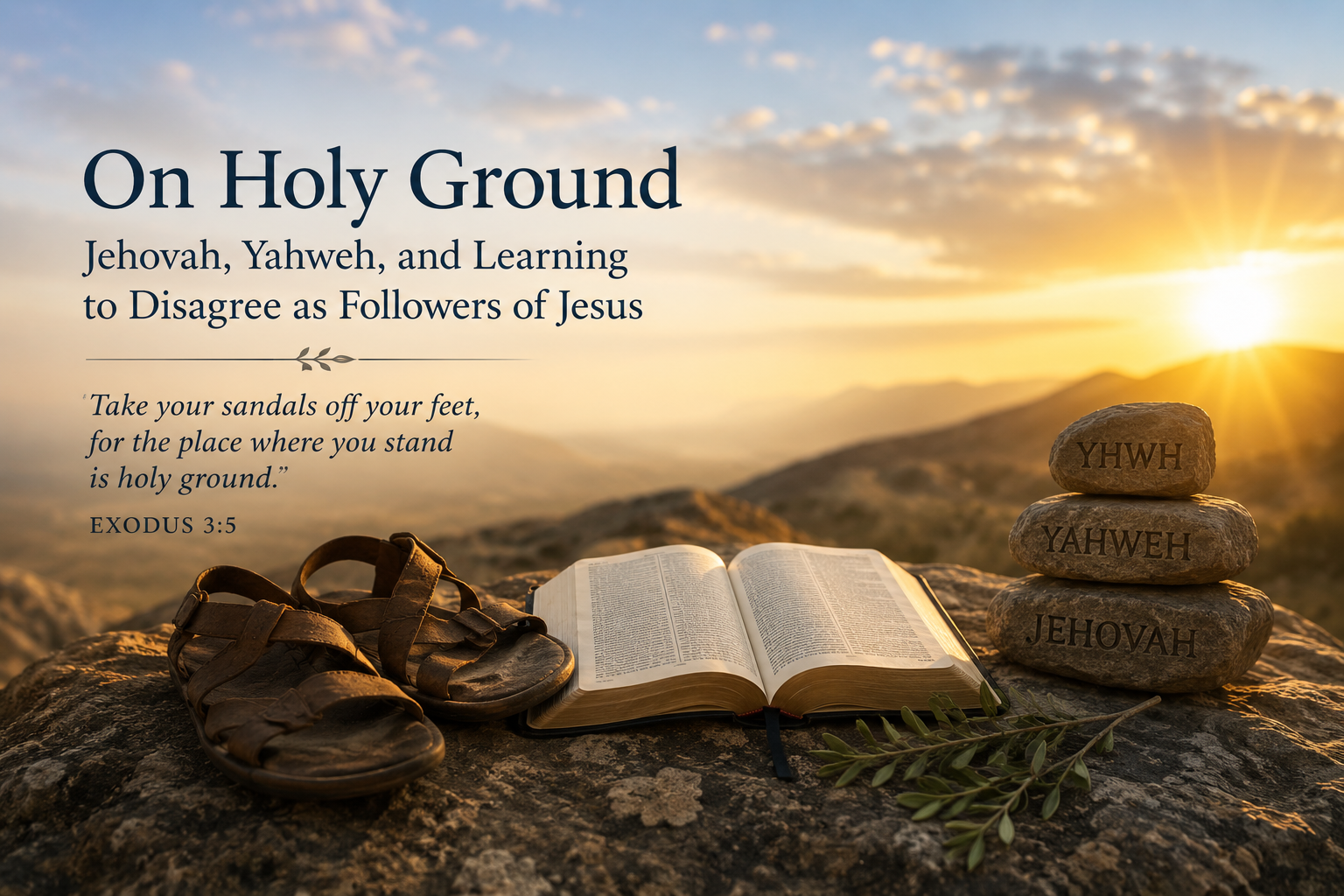
On Holy Ground
“Take your sandals off your feet, for the place where you stand is holy ground.”
Exodus 3:5
There is something deeply troubling about Christians becoming angry with one another over the name of God.
I have heard discussions over whether we should say Jehovah, Yahweh, YHWH, the LORD, or simply God become surprisingly heated. People can begin with a sincere desire to honour God and finish by speaking harshly to one another. Occasionally the temperature rises so far that what began as a discussion about reverence seems almost capable of becoming physical.
There is an irony in that which ought to trouble us.
We can become so determined to defend the name of God that we forget how the God whose name we are defending asks us to treat one another.
The subject itself matters. I do not want to dismiss it with a shrug and say that names are unimportant. Scripture does not treat God’s name casually. At the burning bush Moses asks what he should say when Israel asks who has sent him (Exodus 3:13). God gives the name represented in Hebrew by four consonants, יהוה — YHWH, and says, “This is My name forever” (Exodus 3:15). The Third Commandment warns Israel against bearing or using the name of the LORD wrongly (Exodus 20:7). The Psalms repeatedly call God’s people to honour, praise, and trust in his name (Psalm 8:1; 29:2; 34:3; 113:1–3).
The name matters.
But I have come to believe that arguments over God’s name are often a symptom of a larger problem within the church.
Today it may be Jehovah or Yahweh. Tomorrow it may be baptism, communion, spiritual gifts, predestination, Bible translations, church government, creation, the end times, worship, or some other theological question.
Some of those questions are important. Some are very important. There are matters at the centre of the Christian gospel over which the New Testament itself speaks firmly. Paul does not treat “another gospel” as merely an interesting alternative (Galatians 1:6–9), and he does not treat the resurrection of Christ as a matter Christians may take or leave (1 Corinthians 15:12–19).
Christian unity is not doctrinal indifference.
But neither is every disagreement Galatians 1.
Part of Christian maturity, I have come to believe, is learning the difference.
I Have Not Always Seen It This Way
I came to faith in a Baptist church that, in some respects, had what I would now describe as a fairly fundamentalist outlook.
I say that carefully.
I remain grateful for much that I received there. I was taught to take Scripture seriously. I was taught that faith mattered. I learned that Jesus Christ was not merely an interesting figure from history but Lord and Saviour. Those foundations remain important to me.
But there could also be a tendency to divide complicated questions quickly into black and white.
Biblical or unbiblical.
Right or wrong.
Faithful or unfaithful.
Inside or outside.
Later theological study brought me into contact with a much wider Christian world. I encountered Baptists, Anglicans, Catholics, Pentecostals, Reformed Christians, Wesleyans, and others. They did not agree about everything. Sometimes they disagreed strongly.
Yet I also encountered people who loved Christ deeply, took Scripture seriously, prayed faithfully, cared for others sacrificially, and still reached conclusions different from mine.
That was important for me.
It did not persuade me that truth had ceased to matter.
It taught me something harder:
the truth and my understanding of the truth are not always identical.
That distinction has stayed with me.
There are truths I confess without embarrassment. Jesus Christ is Lord. Christ is risen. Human beings bear the image of God. Sin is real. Grace is necessary. Justice and mercy matter. We are accountable to God.
But not every theological, historical, linguistic, scientific, or ethical question carries the same degree of certainty.
Some questions involve interpretation.
Some involve historical reconstruction.
Some involve evidence from which we draw conclusions rather than things we can observe directly.
Sometimes faithful Christians disagree because one of them is wrong.
Sometimes both have seen only part of the matter.
Sometimes I have been the one who needed correcting.
My world gradually stopped fitting neatly into the black-and-white categories I once relied upon.
I sometimes describe that as learning to see shades of grey, but I do not mean that truth itself has become grey. I mean that I have become more conscious of the limitations of my own grasp of it.
“Now I know in part.”
1 Corinthians 13:12
That is not relativism.
It is creaturely humility.
Pastoral Care Has Changed the Way I Think
Hospital ministry reinforced this lesson.
People do not arrive in hospital as theological systems.
They arrive frightened.
They arrive grieving.
They arrive angry, exhausted, confused, hopeful, or sometimes numb.
Some have a strong and settled Christian faith. Some have faith that has been badly wounded. Some believe things I cannot agree with. Some scarcely know what they believe.
But when somebody is sitting beside the bed of a person they love, the first question is rarely:
“Have you got your theology right?”
The first pastoral question is more likely:
“How can I be present with you here?”
There are times for explanation.
There are times for teaching.
There are times when something harmful or untrue should be challenged.
But pastoral care has taught me that presence often comes before answers.
The person standing before me must never be sacrificed to my desire to win the argument standing between us.
The story of the Good Samaritan speaks powerfully here (Luke 10:25–37). Jesus is not giving us a theory of theological pluralism. He is telling us what it means to become a neighbour.
The Samaritan sees the wounded man.
He comes near.
He tends his wounds.
He carries him.
He makes provision for his care.
“Go and do likewise.”
Luke 10:37
Whatever theological label I may place upon another person, the command to become their neighbour remains.
Sometimes pastoral care begins with two simple words:
Come near.
I Need to Examine My Own Mouth
There is another reason I do not want this article to sound as though I am standing above everyone else correcting their mistakes.
I have not always handled God’s name reverently myself.
I grew up around hotels and later spent much of my working life in workshops and industrial environments. Anyone who has worked in those places knows that language can become rough. Certain expressions become part of the atmosphere. You hear them often enough and eventually they can come out almost without thought.
I have been guilty of saying:
“For God’s sake.”
Usually it has come from frustration.
Something goes wrong.
A spanner slips.
Someone does something foolish.
Patience runs thin.
Out come the words.
I have struggled with that.
Because there would be something badly inconsistent about me becoming angry with another person because they say Jehovah when I think Yahweh is historically more probable, while I casually throw the word God into an expression of irritation.
“You shall not take the name of the LORD your God in vain, for the LORD will not hold him guiltless who takes His name in vain.”
Exodus 20:7
The commandment has a depth greater than simply compiling a list of prohibited expressions. The Hebrew noun šāwʾ can carry the sense of emptiness, vanity, or something done to no good purpose; Brown–Driver–Briggs specifically treats Exodus 20:7 as taking up God’s name “in vain.”2 But surely, at the very least, the commandment should cause us to examine the way God’s name passes our lips.
“Out of the same mouth proceed blessing and cursing. My brethren, these things ought not to be so.”
James 3:10
Before I examine another person’s pronunciation, I need to examine my own mouth.
That puts me inside this discussion rather than above it.
The Christian Life Is Not a One-Off Event
Part of the problem with black-and-white Christianity, at least as I have experienced it, is that faith can sometimes be reduced to whether a person crossed the correct line at some point in the past.
I believe conversion matters.
There is a beginning.
There are moments of confession, repentance, baptism, and commitment that shape a person’s life.
But Jesus did not simply say:
“Make a decision about me.”
He said:
“Follow me.”
“Whoever desires to come after Me, let him deny himself, and take up his cross, and follow Me.”
Mark 8:34
Luke includes one word I find particularly challenging:
“If anyone desires to come after Me, let him deny himself, and take up his cross daily, and follow Me.”
Luke 9:23
Daily.
The Christian life is not a certificate of arrival.
It is a lifelong apprenticeship to Jesus.
Paul describes God’s purpose as conforming us “to the image of his Son” (Romans 8:29). Elsewhere he describes believers as “being transformed” into that same image (2 Corinthians 3:18).
“Not that I have already attained, or am already perfected; but I press on.”
Philippians 3:12
He had not arrived.
Neither have I.
Anyone who has worked with an apprentice understands something of this.
An apprentice does not enter the workshop on Monday morning knowing everything. He learns. He gets things wrong. Someone shows him again. Sometimes he has to unlearn a bad habit. Sometimes he thinks he understands something until the job in front of him shows that he does not.
A decent tradesman does not throw him out of the workshop every time something is fitted incorrectly.
He teaches him.
He corrects him.
He expects him to grow.
There is something in that which resembles discipleship.
We are being formed.
And therefore one of the most important questions I can ask about my theology is not simply:
“Is what I believe correct?”
It is also:
“What is the way I hold this belief making of me?”
Am I becoming more patient?
More truthful?
More merciful?
More capable of listening?
More willing to admit when I am wrong?
More like Jesus?
Paul describes the fruit of the Spirit as “love, joy, peace, longsuffering, kindness, goodness, faithfulness, gentleness, self-control” (Galatians 5:22–23).
If my theological knowledge increases while my patience disappears, something is wrong.
If I become better at winning arguments and worse at loving people, something is wrong.
The goal is not merely theological information.
It is Christlikeness.
Taking Up the Cross Does Not Mean Everything Becomes Easy
Jesus did not promise an easy road.
Taking up the cross is not an invitation to seek suffering or to imagine that every hardship has been directly sent by God. In the Gospels it speaks of costly allegiance to Christ, self-denial, and continuing to follow even when faithfulness costs us something.
There will be struggle.
There will be grief.
There will be unanswered questions.
There will be times when we discover that something we once believed confidently needs to be reconsidered.
Paul tells us that we still “see in a mirror, dimly” and “know only in part” (1 Corinthians 13:12).
Romans 8 describes creation groaning and believers groaning with it as we await redemption (Romans 8:22–25).
Christian hope does not deny the struggle.
It places the struggle within the faithfulness of God.
Faith is not having an answer for every question.
Sometimes faith means continuing to follow Jesus while the question remains.
And that matters when we approach something like the history and pronunciation of God’s name.
We can study the evidence.
We can draw conclusions.
We can say one conclusion appears stronger than another.
But we should not claim a certainty greater than the evidence allows simply because uncertainty makes us uncomfortable.
The Bible Itself Uses a Rich Vocabulary for God
That brings us to the particular question that started this article.
What should we call God?
The Hebrew Scriptures give us a richer answer than we sometimes realise.
The Bible does not use only one term for God.
It uses names, titles, descriptions, and epithets which do not all function linguistically in exactly the same way. Modern scholarship likewise distinguishes YHWH as the personal proper name of Israel’s God from terms such as Elohim, El, Shaddai, and the various El-epithets.3
The opening verse of Genesis uses:
אֱלֹהִים — ʾĕlōhîm
usually translated God:
“In the beginning God created the heavens and the earth.”
Genesis 1:1
There is also:
אֵל — ʾEl
a common Semitic term for God or a god, depending upon context.
We encounter:
אֵל עֶלְיוֹן — ʾEl ʿElyôn
God Most High
(Genesis 14:18–22)
and:
אֵל עוֹלָם — ʾEl ʿÔlām
Everlasting God
(Genesis 21:33)
There is:
אֵל שַׁדַּי — ʾEl Šadday
traditionally translated God Almighty (Genesis 17:1).
That traditional translation has a long history, but the precise etymology of Shaddai remains disputed; proposed derivations have drawn on several different Semitic roots and comparisons.4
That small uncertainty is instructive in itself.
Sometimes good biblical scholarship says:
We do not know with complete certainty.
There is also:
אֲדֹנָי — ʾădōnāy
usually translated Lord.
And among this rich biblical vocabulary stands the distinctive personal name of Israel’s God:
יהוה — YHWH
The different expressions are not interchangeable in every linguistic sense. Elohim, Adonai, El Shaddai, and YHWH do not all perform precisely the same function.
But Scripture itself plainly speaks of the one God through a rich range of language.
One book that has helped shape my own devotional thinking here is Nathan J. Stone’s Names of God. Stone works through a range of Old Testament names and titles with a deliberately devotional purpose, asking what they reveal about God’s character and how Christians may understand their fulfilment in the person and work of Jesus Christ. I would not use Stone as the final authority for questions of Hebrew etymology or historical pronunciation, but his pastoral instinct is valuable: the names matter because they direct our attention beyond the words themselves to the God who makes himself known.16
That ought to make us cautious before insisting that one English form is the only legitimate way a human being may address God.
The Elohistic Psalter
The Psalms provide a fascinating example.
Scholars commonly refer to Psalms 42–83 as the Elohistic Psalter because this section shows a striking preference for the designation Elohim.5
One particularly useful comparison is Psalm 14 and Psalm 53.
The psalms are closely related.
Psalm 14:2 speaks of YHWH looking down from heaven.
Psalm 53:2 uses Elohim.
The God has not changed.
The designation has.
Scholars have discussed why this happened. Editorial shaping is widely considered part of the explanation, but the precise motives remain debated. Laura Joffe’s detailed analysis argues that the unusual distribution reflects skilled editorial activity, while rejecting the simple explanation that it arose from reluctance to pronounce the Tetragrammaton.6
Again we meet the difference between evidence and interpretation.
We can observe the pattern.
Explaining exactly why an ancient editor produced it requires further inference.
Psalm 42 gives us something even more pastorally important:
“As the deer pants for the water brooks, so pants my soul for You, O God.”
Psalm 42:1
The psalmist cries to Elohim.
No one imagines that his prayer has been misdirected because he did not use YHWH in that sentence.
I have sat beside people whose prayers became much simpler than any theological discussion.
Sometimes all someone can manage is:
“God, help me.”
Or:
“Lord, stay with me.”
I find it difficult to believe that the God who heard Israel crying under oppression is confused because a frightened person in a hospital bed has not reconstructed an ancient Hebrew pronunciation correctly.
YHWH and the Burning Bush
Nevertheless, YHWH has a distinctive place in the Hebrew Scriptures.
The four Hebrew letters are:
יהוה
commonly transliterated:
YHWH
They are often called the Tetragrammaton, meaning simply “four letters”.
YHWH is the distinctive personal name of Israel’s God and is by far the most frequent divine designation in the Hebrew Bible; it stands prominently in the biblical accounts of God’s self-disclosure, including Exodus 3 and 6.7
“and they say to me, ‘What is His name?’ what shall I say to them?”
Exodus 3:13
God answers:
אֶהְיֶה אֲשֶׁר אֶהְיֶה
ʾehyeh ʾăšer ʾehyeh
often rendered:
“I AM WHO I AM,”
although the Hebrew can also carry the sense:
“I WILL BE WHO I WILL BE.”
The next verse connects that revelation with YHWH (Exodus 3:15).
There is an evident relationship between ʾehyeh and YHWH and the Hebrew verbal field associated with being or becoming. The precise grammatical derivation and original meaning of the name, however, have been debated.15
So I would be cautious when anyone claims that the Hebrew gives us one simple, indisputable dictionary definition of YHWH.
There is something else in Exodus 3 that interests me even more.
“I will certainly be with you.”
Exodus 3:12
Moses is not receiving a password.
He is encountering the living God who promises his presence.
Was the Name Pronounced Yahweh?
Ancient Hebrew writing did not originally use the later system of written vowel points familiar from medieval Hebrew manuscripts.
The text gives us the consonants:
Y-H-W-H
but those consonants alone do not preserve every sound needed for us to reproduce the ancient pronunciation with absolute certainty.
The dominant scholarly reconstruction is:
Yahweh.8
There are good reasons for that conclusion.
The shortened form:
יָהּ — Yāh
appears in Scripture.
We hear it in:
הַלְלוּ־יָהּ — haləlû-yāh
“Praise Yah.”
We still say it whenever we say:
Hallelujah.
Shortened forms of the divine name also appear within Hebrew personal names. Ancient sources also preserve Greek transcriptions such as Iao and related forms; these belong to the wider body of evidence scholars weigh when reconstructing the ancient pronunciation.8
So I am comfortable saying:
Yahweh is probably much closer to the ancient pronunciation than Jehovah.
But I deliberately retain the word probably.
We are dealing with historical reconstruction, not an ancient recording.
That is an important distinction.
Humility belongs in scholarship too.
Why Jewish Readers Said Adonai
At some point in Jewish history, reverence for the divine name led increasingly to the practice of not pronouncing YHWH during ordinary reading.
Instead, readers commonly said:
אֲדֹנָי — Adonai
meaning Lord.
The precise history and development of the practice are more complicated than a single date or rule, but by the Second Temple period the substitution of Adonai for YHWH was already established in spoken recitation, and later English translations inherited the convention of representing YHWH as LORD.9
That practice survives indirectly in many English Bibles.
“The LORD is my shepherd.”
Psalm 23:1
When LORD appears in capitals or small capitals, the underlying Hebrew is normally YHWH.
So Christians who say the LORD are not necessarily avoiding the biblical text.
They are participating in a translation convention with very old roots in Jewish reverence for the divine name.
The Masoretes and the Road to Jehovah
Many centuries after the biblical books were written, Jewish scholars known as the Masoretes carefully preserved the traditional Hebrew text and its reading.
They developed systems of vowel points, accents, and textual notes.
YHWH created an unusual situation.
The consonants written in the text were:
יהוה — YHWH
but traditional public reading called for:
Adonai — Lord.
The vowel notation associated with YHWH therefore functioned as a reading cue.
It was not simply a record of the ancient original vowels of the divine name.10
We can see this particularly clearly when Adonai and YHWH occur together. Rather than reading “Adonai Adonai”, the tradition uses Elohim as the substitute, producing what English readers often see as:
Lord GOD.
This variation helps show what the vowel notation was doing.
Later Christian scholars encountered Hebrew manuscripts containing the consonants of YHWH together with these reading vowels.
When the consonants and vowels were treated as though they represented the normal pronunciation of one word, forms resembling:
Yehowah
or:
Yehovah
developed.
Through medieval Latin usage and later European spelling conventions came forms such as:11
Iehoua
and:
Iehova
and eventually the English:
Jehovah.4
This is the historical path behind the word.
It did not simply appear from nowhere.
But neither is it generally regarded as the ancient Israelite pronunciation.
Modern scholarship therefore usually distinguishes:
- YHWH — the consonantal Hebrew name.
- Yahweh — the leading reconstruction of its ancient pronunciation.
- Jehovah — a later Christian form arising through the history of the Masoretic reading tradition and its interpretation by Christian scholars.
That distinction tells the history without using the history as a weapon.
Jehovah Belongs to Christian History
It is also important not to treat Jehovah as though it were a recent invention.
William Tyndale used the form Iehouah in his English Pentateuch of 1530. His rendering can be seen directly at Exodus 6:3 and elsewhere in the Pentateuch.12
Later English translations continued to use the form selectively, and the King James Version of 1611 retained Jehovah explicitly in passages including Exodus 6:3; Psalm 83:18; Isaiah 12:2; and Isaiah 26:4.13
The word therefore has a long history within English-speaking Christianity.
It has appeared in Bible translations, prayers, sermons, theological writing, and hymns.
Many Christians will recognise it from the old hymn:
“Guide me, O thou great Jehovah.”14
That history should make us careful before dismissing the word as meaningless or treating someone who uses it as though they know nothing of Scripture.
At the same time, historical usage does not make Jehovah the most probable ancient pronunciation of YHWH.
We can hold both facts together.
Yahweh is generally regarded as the stronger historical reconstruction.
Jehovah is a later form with a genuine and longstanding place in Christian language.
Understanding that distinction should lead to education rather than accusation.
The Argument Is a Symptom of Something Larger
This brings us back to the larger problem.
The church has disagreed since its earliest days.
Acts records sharp disagreements. Paul’s letters were written to real churches with real problems. Sometimes doctrine was at stake. Sometimes personality was involved. Sometimes cultural difference was involved. Sometimes Christians simply struggled to live together.
That should not surprise us.
What should concern us is what disagreement can become.
We can begin with:
“I think you are mistaken.”
Then move to:
“People who think like you are the problem.”
Then:
“Your church is not really faithful.”
And eventually:
“I am not sure someone like you can truly belong to Christ.”
A question becomes a fence.
And if we build enough fences, Christian fellowship begins to resemble a row of neighbouring properties whose occupants seldom speak over the boundary.
“Therefore let us pursue the things which make for peace and the things by which one may edify another.”
Romans 14:19
Romans 14 does not mean every doctrine is negotiable.
But it does show that Paul recognised matters over which believers could differ without treating one another as enemies.
“Who are you to judge another’s servant?”
Romans 14:4
“endeavoring to keep the unity of the Spirit in the bond of peace.”
Ephesians 4:3
Notice the word maintain.
Christian unity is not something we manufacture by pretending disagreement does not exist.
It is something we receive and are called to guard.
“that they all may be one.”
John 17:21
That does not require uniformity.
But surely it should make us reluctant to destroy fellowship casually.
Not every disagreement is a gospel boundary, and Christian maturity includes learning the difference.
Discernment Is Not Condemnation
I still believe in discernment.
Ideas matter.
Doctrine matters.
Truth matters.
There are beliefs that harm people.
There are interpretations that need challenging.
There are times when Christian leaders must speak clearly.
But discernment is not the same as condemnation.
I can conclude that an idea is wrong without pretending that I know the complete standing before God of the person who holds it.
“Therefore judge nothing before the time, until the Lord comes.”
1 Corinthians 4:5
Jesus tells his disciples that the Holy Spirit will convict concerning sin, righteousness, and judgment (John 16:8).
That has become an important pastoral reminder for me.
I can teach.
I can listen.
I can reason.
I can witness.
I can disagree.
Sometimes I can correct.
But I am not the Holy Spirit.
And there is considerable freedom in remembering that.
I do not need to finish every argument.
I do not need to force every person into my theological framework.
I can speak truthfully and still trust God with the other person.
And perhaps even harder, I can trust God with me.
Because the Holy Spirit may still have something to correct in both of us.
What Happens When Someone Says Jehovah?
Perhaps someone says Jehovah.
What happens inside me?
Do I immediately prepare a correction?
Do I classify them?
Do I assume that using one word tells me everything else they believe?
Or can I listen first?
Perhaps they grew up singing an old hymn.
Perhaps their Bible used the word.
Perhaps it is simply the form by which they learned to speak reverently of God.
There may be an opportunity to explain the history:
“The Hebrew text gives us YHWH. Jewish readers came to use Adonai as the spoken substitute. The Masoretic tradition preserved that reading practice, and later Christian scholarship contributed to the form Jehovah. Most Hebrew scholars think Yahweh is probably closer to the ancient pronunciation.”
That is teaching.
No humiliation is required.
Nothing is gained by making another person feel foolish.
The purpose of learning should be to illuminate, not humiliate.
And then perhaps we can move to the larger question:
What does Scripture tell us about the God whose name those four Hebrew letters represent?
Now we have moved from correcting a word to opening Scripture together.
From YHWH to Jesus Christ
For Christians, the discussion becomes particularly significant when we reach the New Testament.
“whoever calls on the name of the LORD shall be saved.”
Joel 2:32
In the Hebrew text, LORD represents YHWH.
Paul quotes that passage:
“whoever calls on the name of the Lord shall be saved.”
Romans 10:13
But immediately around that quotation Paul is speaking about confessing Christ as Lord:
“confess with your mouth the Lord Jesus”
Romans 10:9
That is theologically significant.
Paul takes a passage concerning calling upon YHWH and places it within his proclamation of Jesus Christ as Lord.
“My Lord and my God!”
John 20:28
“The Word became flesh.”
John 1:14
“He who has seen Me has seen the Father.”
John 14:9
For the Christian, then, the journey cannot end with recovering the probable sound of an ancient Hebrew name.
The purpose of revelation is not simply to pronounce God correctly.
It is to know him.
The God Behind the Name
Return to the burning bush.
Before we become absorbed in vowels and manuscripts, listen again to what God tells Moses.
He has seen the misery of his people.
He has heard their cry.
He knows their suffering.
And he has come down to deliver them (Exodus 3:7–8).
That tells us something about the One who bears the name YHWH.
He sees.
He hears.
He knows suffering.
He judges oppression.
He remembers covenant.
He shows mercy.
He delivers.
“The LORD is my shepherd.”
Psalm 23:1
“Be merciful to me, O God, be merciful to me!”
Psalm 57:1
YHWH.
Elohim.
The same faithful God.
Knowing the history of his name is worthwhile.
Knowing his character matters even more.
And for Christians there is another question still:
Is that character being formed in us?
Are We Becoming Like Jesus?
Perhaps this is where the argument over God’s name finally brings us.
I can pronounce Yahweh rather than Jehovah and still be proud.
I can understand the Masoretic reading tradition and still be impatient.
I can know enough Hebrew to correct someone and lack enough love to know when I should keep quiet.
I can win the argument and lose the person.
So I need another question alongside:
“What is true?”
I need to ask:
“Is the way I am holding this truth making me more like Jesus?”
Can I disagree without hatred?
Can I correct without humiliating?
Can I listen without merely waiting for my turn to speak?
Can I admit uncertainty where uncertainty exists?
Can I recognise a brother or sister whose theology is not identical to mine?
Can I walk beside someone whose beliefs I cannot share?
Can I control my own mouth when I am frustrated?
Can I remain present when there is no neat answer?
Can I show mercy?
Can I take up my cross today?
These are not alternatives to truth.
They are part of what Christian truth is meant to produce in us.
Paul writes of Christ being formed in believers (Galatians 4:19).
That work is not finished in me.
It is not finished in the person standing opposite me either.
We are both still somewhere along the road.
Conclusion: On Holy Ground
The historical picture, then, can be stated without hostility.
The Hebrew Scriptures use a rich vocabulary for God, including El, Elohim, El Elyon, El Shaddai, El Olam, Adonai, and the distinctive divine name YHWH.
The Elohistic Psalter reminds us that Scripture itself can use different divine designations while speaking of the one God.
YHWH is the four-consonant personal name of Israel’s God.
Its ancient pronunciation cannot be recovered with the certainty of direct observation, although Yahweh remains the dominant scholarly reconstruction.
Jewish reading tradition came to substitute Adonai for YHWH.
The Masoretic scribes preserved that reading tradition through vowel notation, and later Christian readers combined the written consonants with those reading vowels in a way that contributed to Jehovah.
Jehovah therefore has a genuine history within Christian language, even though it is unlikely to reproduce the ancient Israelite pronunciation.
That is worth teaching.
But the argument over God’s name also reveals something larger about us.
Can we hold conviction without contempt?
Can we distinguish the heart of the gospel from questions over which faithful Christians may disagree?
Can we pursue truth without destroying fellowship?
Can we remember that the Christian life is not a one-off declaration that we have arrived, but a daily journey in which the Holy Spirit continues to form us into the likeness of Jesus Christ?
And can we remember, when the discussion becomes heated, where Moses was standing?
He came towards the burning bush wanting answers.
God told him:
“Remove the sandals from your feet.”
Exodus 3:5
Moses did not approach arguing.
He approached barefoot.
Perhaps that remains the right posture.
Tell the truth.
Study carefully.
Do not claim certainty beyond the evidence.
Hold convictions without turning them into weapons.
Distinguish discernment from condemnation.
Protect Christian fellowship wherever truth and conscience permit.
Examine our own mouths before examining another person’s pronunciation.
Come near to wounded people.
Trust Jesus Christ and the Holy Spirit with work that finally belongs to them.
And remember that the purpose of knowing God’s name is not merely that we pronounce it correctly.
It is that we know him, honour him, bear his name faithfully, love one another, and become increasingly like the Christ we have chosen to follow.
For we are still on the road.
And we are still standing on holy ground.
Endnotes
- Holy Bible, New King James Version. Scripture quotations are taken from the New King James Version®. Copyright © 1982 by Thomas Nelson. Used by permission. All rights reserved. The NKJV permits quotation within its stated gratis-use guidelines when the translation is properly acknowledged. NKJV version and copyright information. ↩
- Francis Brown, S. R. Driver, and Charles A. Briggs, A Hebrew and English Lexicon of the Old Testament, s.v. שָׁוְא (šāwʾ), defining the noun in terms including “emptiness” and “vanity” and treating Exodus 20:7 as taking up God’s name “in vain.” BDB entry. ↩
- Collin Cornell, “Names of God in the Hebrew Bible,” Oxford Research Encyclopedia of Religion (2019), distinguishing YHWH as the personal proper name from Elohim and other divine titles and epithets. Oxford Academic. ↩
- Godwin Mushayabasa, “The Effect of Etymology on the Rendering of the Divine Epithet (El) Shaddai in the Peshitta Version,” Journal for Semitics 19, no. 1 (2010): 19–35. The article surveys competing etymological proposals and the difficulty ancient translators faced in rendering the epithet. North-West University repository. ↩
- Joel S. Burnett, “Forty-Two Songs for Elohim: An Ancient Near Eastern Organizing Principle in the Shaping of the Elohistic Psalter,” Journal for the Study of the Old Testament 31, no. 1 (2006): 81–101. Burnett identifies Psalms 42–83 as the Elohistic Psalter and discusses Elohim as an organizing feature of the collection. DOI. ↩
- Laura Joffe, “The Elohistic Psalter: What, How and Why?” Scandinavian Journal of the Old Testament 15, no. 1 (2001): 142–169. Joffe argues for deliberate editorial activity and concludes that the pattern was unrelated to a reluctance to pronounce the Tetragrammaton. DOI. ↩
- Collin Cornell, “Names of God in the Hebrew Bible,” Oxford Research Encyclopedia of Religion (2019). Cornell describes YHWH as the four-letter personal proper name and the most common designation for God in the Hebrew Bible, with particular attention to Genesis 4, Exodus 3, Exodus 6, and Ezekiel 20. Oxford Academic. ↩
- Bill T. Arnold, The Cambridge Introduction to the Old Testament, 2nd ed. (Cambridge: Cambridge University Press, 2026), sidebar 1.2, “Israel’s God, Yahweh,” describes YHWH as probably pronounced something like “Yahweh,” while stressing that the exact pronunciation remains uncertain. For ancient Greek phonetic transcriptions of the Tetragrammaton, including ιαω, see Alexander Kulik, “Counting on God’s Name: The Numerology of Nomina Sacra,” Harvard Theological Review 118, no. 3 (2025). Cambridge book; Harvard Theological Review. ↩
- Collin Cornell, “Names of God in the Hebrew Bible,” notes that already in the Second Temple era spoken recitation replaced YHWH with Adonai, and that the convention of representing the divine name as LORD has ancient roots. Oxford Academic. ↩
- James C. VanderKam explains that the Masoretic Text combines an older consonantal text with vowels, accents, cantillation marks, and other notes added by medieval Jewish Masoretes. The traditional reading practice in which YHWH is read as Adonai, or in relevant contexts Elohim, is also described in standard Jewish reference material. VanderKam, Cambridge Companion chapter; Jewish Encyclopedia, “Adonai”. ↩
- Alexander Kulik, “Counting on God’s Name: The Numerology of Nomina Sacra,” Harvard Theological Review 118, no. 3 (2025), discusses the medieval Latin development of forms that contributed to the later Christian Jehovah tradition. DOI. ↩
- William Tyndale, The Pentateuch (1530), Exodus 6:3, “but in my name Iehouah was I not known unto them.” The linked transcription modernizes some spelling but preserves Iehouah in the relevant passages. Project Gutenberg transcription. ↩
- The King James Version uses Jehovah explicitly at Exodus 6:3, Psalm 83:18, Isaiah 12:2, and Isaiah 26:4. Kulik also notes the presence of the form in Tyndale’s Pentateuch, the Geneva Bible, the Bishops’ Bible, and the KJV. KJV passages; Harvard Theological Review. ↩
- William Williams’s Welsh hymn dates from 1745; Peter Williams’s English translation beginning “Guide me, O Thou great Jehovah” appeared in 1771. Hymnary.org text authority. ↩
- Bill T. Arnold, The Cambridge Introduction to the Old Testament, 2nd ed. (Cambridge: Cambridge University Press, 2026), sidebar 1.2, notes that the origin and precise meaning of YHWH remain uncertain while most scholars relate the name to the Hebrew verb “to be”; he also stresses that several proposed semantic explanations remain debated. Cambridge publisher page. ↩
- Nathan J. Stone, Names of God (Chicago: Moody Publishers, 2010; originally published 1944). Moody describes the book as a devotional study of the names of God in the Old Testament, emphasising what those names reveal about God’s character and their fulfilment in the person and work of Jesus Christ. Moody Publishers. ↩
Bibliography (Chicago Style)
Arnold, Bill T. The Cambridge Introduction to the Old Testament. 2nd ed. Cambridge: Cambridge University Press, 2026. Publisher page.
Brown, Francis, S. R. Driver, and Charles A. Briggs. A Hebrew and English Lexicon of the Old Testament. Oxford: Clarendon Press, 1907. S.v. שָׁוְא. Digital entry.
Burnett, Joel S. “Forty-Two Songs for Elohim: An Ancient Near Eastern Organizing Principle in the Shaping of the Elohistic Psalter.” Journal for the Study of the Old Testament 31, no. 1 (2006): 81–101. https://doi.org/10.1177/0309089206068844.
Cornell, Collin. “Names of God in the Hebrew Bible.” Oxford Research Encyclopedia of Religion. Oxford University Press, 2019. https://doi.org/10.1093/acrefore/9780199340378.013.144.
Joffe, Laura. “The Elohistic Psalter: What, How and Why?” Scandinavian Journal of the Old Testament 15, no. 1 (2001): 142–169. https://doi.org/10.1080/09018320152395958.
Mushayabasa, Godwin. “The Effect of Etymology on the Rendering of the Divine Epithet (El) Shaddai in the Peshitta Version.” Journal for Semitics 19, no. 1 (2010): 19–35. Repository record.
Stone, Nathan J. Names of God. Chicago: Moody Publishers, 2010. Originally published 1944. Publisher page.
Holy Bible, New King James Version. Nashville: Thomas Nelson, 1982. Version and copyright information.
Tyndale, William. The Pentateuch. 1530. Digital transcription.
Williams, William. “Guide Me, O Thou Great Jehovah.” 1745. English translation by Peter Williams, 1771. Hymnary.org.
Kulik, Alexander. “Counting on God’s Name: The Numerology of Nomina Sacra.” Harvard Theological Review 118, no. 3 (2025). https://doi.org/10.1017/S001781602510076X.
VanderKam, James C. “Texts, Titles, and Translations.” In The Cambridge Companion to the Hebrew Bible/Old Testament, edited by Stephen B. Chapman and Marvin A. Sweeney, 9–27. Cambridge: Cambridge University Press, 2016. https://doi.org/10.1017/CBO9780511843365.002.